
On this page
Impedance and measurement ports
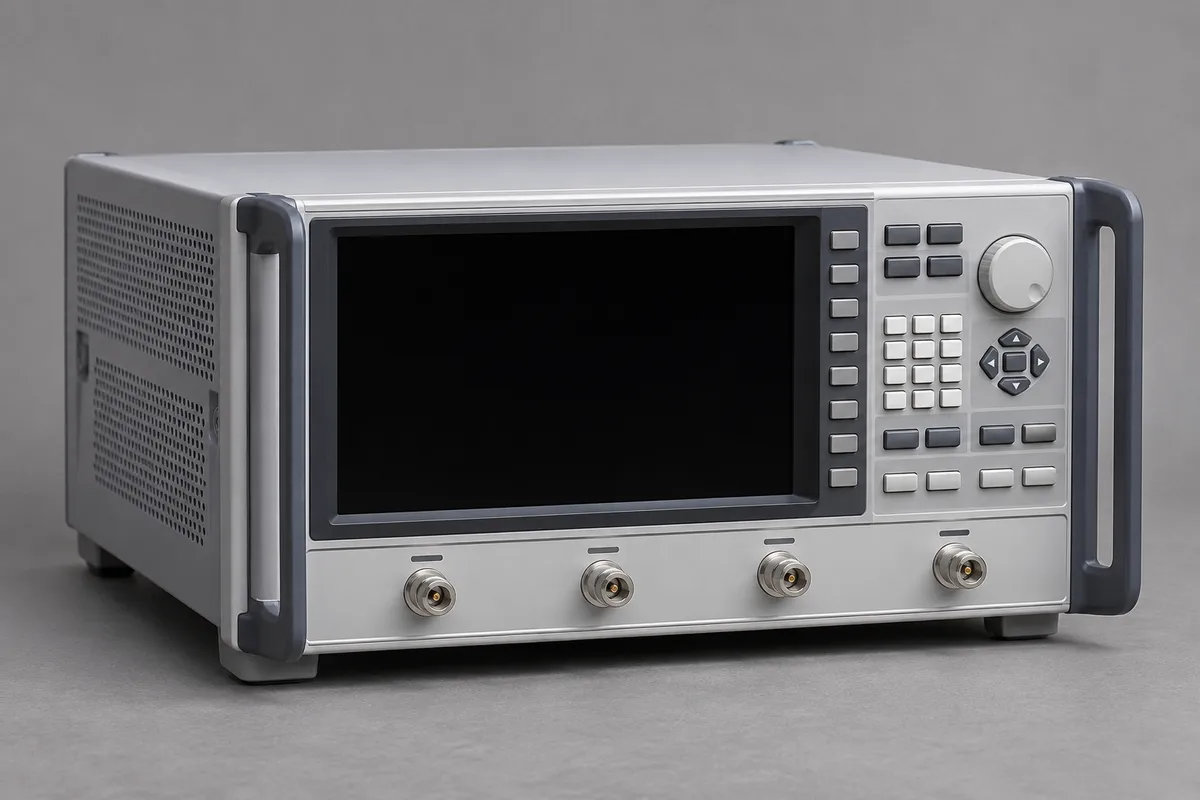
Identify port count, impedance, connector type and the measurements required at each frequency. If a calibration kit or electronic module is in regular use, include its identification and reference plane. Specify whether you need the analyzer ports, kit or an assembled fixture checked.
A test stand checking only insertion loss may need two-port magnitude readings across a frequency band. A fixture used to measure reflection phase raises a different question. Identify which measurement the acceptance record actually contains before specifying a full set of analyzer tests.
Specifications and service checks
For a filter with a narrow notch, a coarse frequency sweep can miss the deepest point. Supply the working span and point count or frequency step when the disagreement concerns notch depth. A wide sweep that looks smooth may sample different frequencies.
- Range and configuration
- Specify the S-parameters, frequency span, port impedance and required dynamic range. S11 describes reflection at port 1, while S21 describes forward transmission.
- Manufacturers and models
- Keysight's E5061B ENA network analyser is available in different test-set configurations. Quote the exact option and connectors.
- What we check
- Perform the appropriate port calibration and then verify response with independent characterised devices. Record the measurement plane and test cables.
- Reference equipment and accuracy
- Use compatible calibrated standards and an independent verification set. At high loss, noise floor and residual leakage can dominate uncertainty.
- When to repeat the check
- Verify performance after replacing a test cable or disturbing a connector and review formal calibration against the drift record.
Technical references E5061B ENA Series Vector Network Analyzer