
On this page
Standpipe area and the falling-head reading
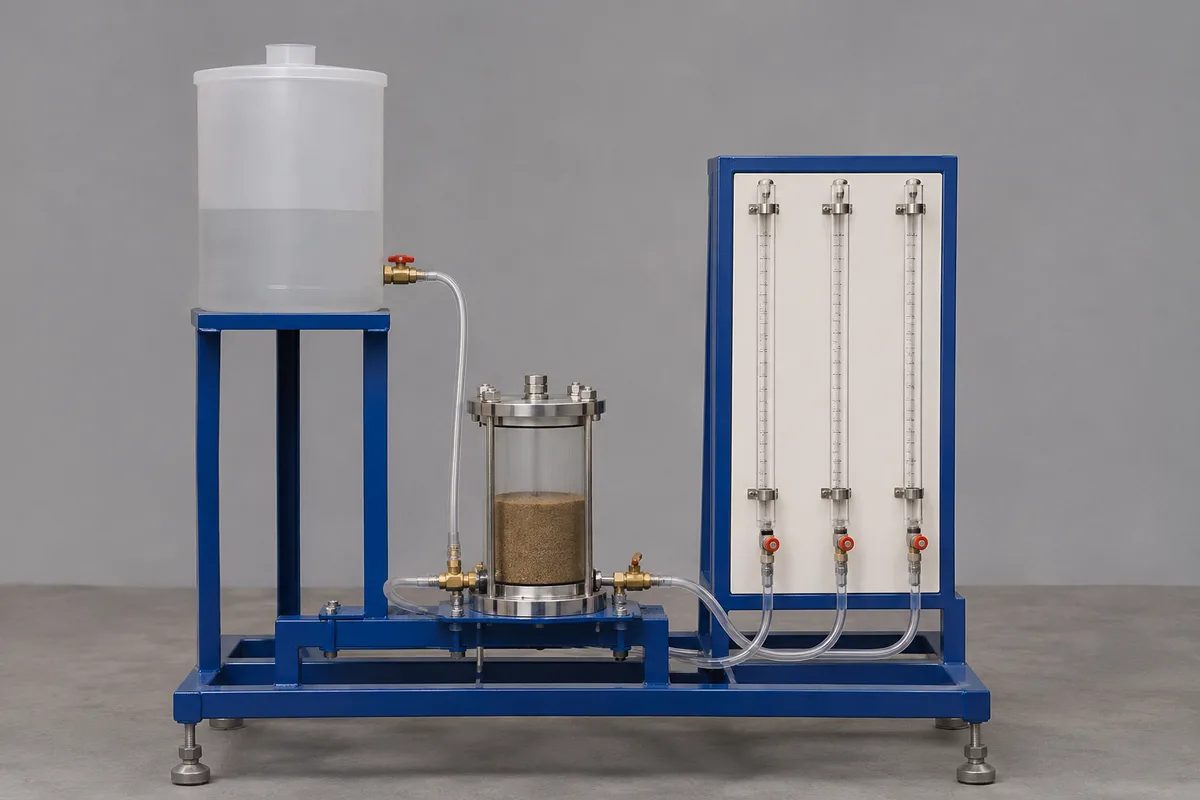
A falling-head worksheet uses the standpipe’s internal cross-sectional area. Switching from a narrow tube to a wider one changes that calculation even if both scales read the head correctly. Identify the standpipe, the cell dimensions and the scale used for the water levels. In a constant-head setup the collected volume and collection interval may matter instead. A copy of the blank worksheet makes the distinction clear.
Permeability apparatus quantities
Measuring tubes and transducers are identified with their readouts. The equipment results are then traceable to the quantities entering the permeability calculation. The report retains the apparatus arrangement and calculation requirements specified by the laboratory’s method.
Specifications and service checks
For a falling-head setup, the standpipe bore and observed change in head both enter the result. Identify which interchangeable standpipe was used before comparing the equipment dimensions from successive visits.
- Range and configuration
- Describe cell diameter and specimen length, the applied head and the collected volume. Constant-head and falling-head systems require different records.
- Manufacturers and models
- Humboldt supplies constant-head permeameter cells in several sizes. CONTROLS lists constant-head cells with nominal inside diameters of 75 and 114 mm.
- What we check
- Verify head scale or pressure indication, cell dimensions, volume graduations and collection time. Permeability itself is calculated from a specimen test.
- Reference equipment and accuracy
- A traceable length reference, volume or mass reference and timer support the component checks. Include a thermometer when a viscosity correction is used.
- When to repeat the check
- Recheck a standpipe or receiver after replacement and inspect seals before a series of measurements.
Technical references Humboldt product reference · CONTROLS product reference