
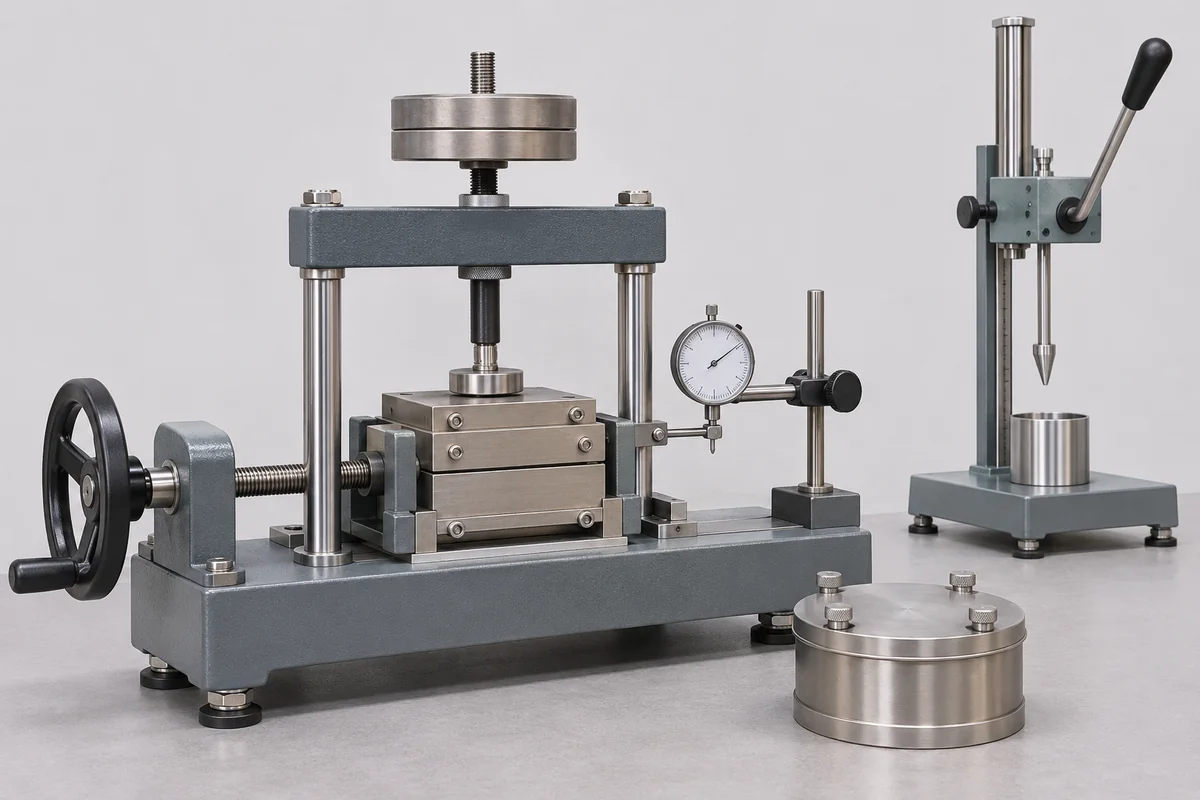
California bearing ratio apparatus
For California bearing ratio apparatus, identify the force system, penetration indication and loading arrangement. List the moulds, piston and surcharge pieces separately where their dimensions or mass need results. Include the method and working intervals. A force comparison on the frame does not cover the penetration measurement or the specimen preparation used to calculate a CBR result.
Which cone penetrometer?
Cone penetrometer can describe laboratory or field equipment. Give the model, test purpose and whether the quantity is penetration depth, applied load or measured resistance. For a laboratory cone, identify the cone assembly and release arrangement; for an instrumented system, list its channels. RTS needs that distinction before reviewing references, fixture requirements and the possible scope of measurement.
Dynamic cone penetrometer components
A dynamic cone penetrometer enquiry should list the hammer, drop arrangement, rods, cone and penetration scale. Provide the component dimensions and mass requirements from the method, including any replaced parts. The apparatus checks concern these defined quantities. Interpreting penetration per blow as a soil or pavement property requires the separate field procedure and the correlation specified by its owner.
Liquid limit device
Identify whether the liquid limit device is a cup-and-cam apparatus or another method's instrument. For a cup device, list the cup, base, grooving tool and controlled movement requirements. Include the counter or timing function if assessed. The equipment examination should use the applicable method's requirements; results from a different apparatus type should not be treated as automatically equivalent.
Direct shear apparatus channels
For direct shear apparatus, identify the shear-force measurement, normal loading system and horizontal and vertical displacement channels. Include the shear-box dimensions and the requested travel or rate checks. List each sensor with its readout. A result for a detached load cell does not automatically describe every channel or the alignment of the complete test arrangement.
Triaxial test apparatus
A triaxial test apparatus enquiry should identify axial force, displacement, cell pressure and any pore-pressure or volume-change measurement used. State the test mode and which channels enter the calculation. Include the cell, controller and software identifiers. The proposed assessment must define the individual measurement chains; verifying pressure alone does not establish the complete system's performance for a soil test.
Permeability apparatus quantities
State whether the permeability apparatus uses a constant-head, falling-head or another arrangement. Identify the head or pressure readings, collected volume, time and specimen dimensions used in the calculation. Include the measuring tubes or transducers with their identifiers. The enquiry should specify checks of those quantities rather than ask for an unexplained calibration of the calculated permeability value.
Plate load test apparatus
For plate load test apparatus, list the loading system, force reference, settlement indicators and plate dimensions. Show the reference support arrangement used for displacement readings and identify each gauge. The provider needs to confirm the required loads and available references before accepting work. Instrument measurement records do not themselves establish ground-bearing performance or replace the specified field test.
Core cutter dimensional reference
Identify each core cutter by its own mark and provide the dimensions or internal volume required by the procedure. Note cutting-edge damage or distortion before dispatch. If the laboratory calculates volume from dimensions, state the measurement and calculation requirements explicitly. A nominal size on the case does not establish the volume of the particular cutter used for the field sample.
Soil auger as sampling equipment
A soil auger is normally a sampling tool rather than an instrument with a calibrated indication. Identify any dimensional requirement that needs verification and provide the tool drawing or sampling specification. Record the auger type and condition in the sampling-equipment register. A dimensional check should not be described as certification that a recovered sample represents the ground conditions at the site.
Prepare the order by measurement channel
Attach the current method, apparatus diagram and sensor list. RTS will review the available measurements, references and reporting laboratory before confirming a visit or dispatch. Keep separate requests for material testing, equipment maintenance and measurement records distinguishable. Give the laboratory contact, site location and any period when the apparatus is free from a long-running test.