
On this page
Phase rotation and any voltage display
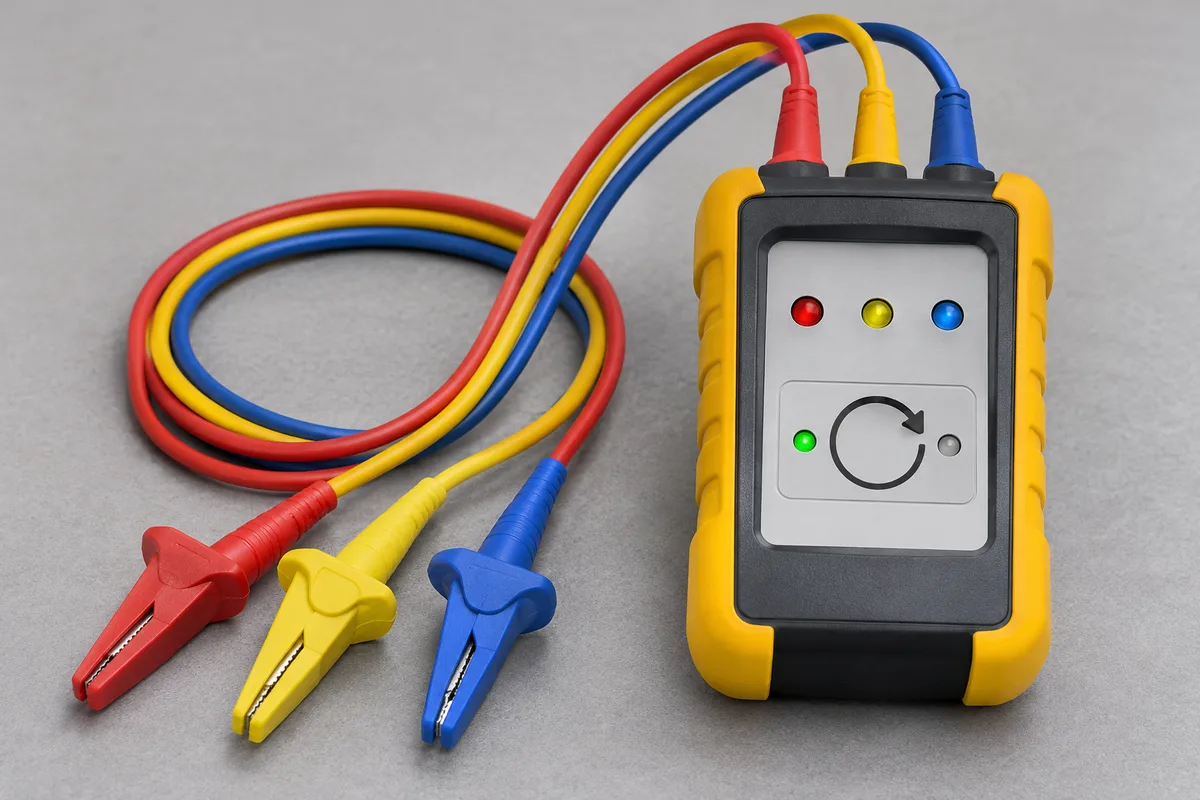
An electrician can ask for the clockwise and anticlockwise indications to be checked with the leads labelled L1, L2 and L3. If the instrument also has a voltage display, give the voltage points and frequency you use. This gives you a record of the direction function and, where fitted, the numerical readings, with enough detail to identify the lead set.
Phase sequence meters
State the indication your maintenance procedure requires and identify any motor-rotation function. Include lead markings and the input conditions from the equipment manual. Ask for the intended functional verification to be named explicitly in the quotation. A phase-sequence indication should not be described as an angle calibration or a certificate for the connected installation.
Specifications and service checks
A maintenance crew may use one instrument to check phase order and another function on the same unit to identify motor rotation. Quote the indication the operator relies on. A correct three-phase sequence display does not by itself verify every motor-rotation mode.
- Range and configuration
- Specify the operating voltage and frequency and the phase order used by the site. Indicator response near its lower operating voltage may be relevant.
- Manufacturers and models
- Fluke 9040 is a phase rotation indicator that identifies the order of three phases. It reports direction rather than a continuously variable angle.
- What we check
- Check the indication for known phase sequences at suitable voltage and frequency. Where individual-phase presence is indicated, verify that function separately.
- Reference equipment and accuracy
- Use a controlled three-phase source with independently established phase order, voltage and frequency.
- When to repeat the check
- Verify after a lead replacement or a discrepancy with a known phase sequence.
Technical references Fluke 9040 Phase Rotation Indicator Tester