
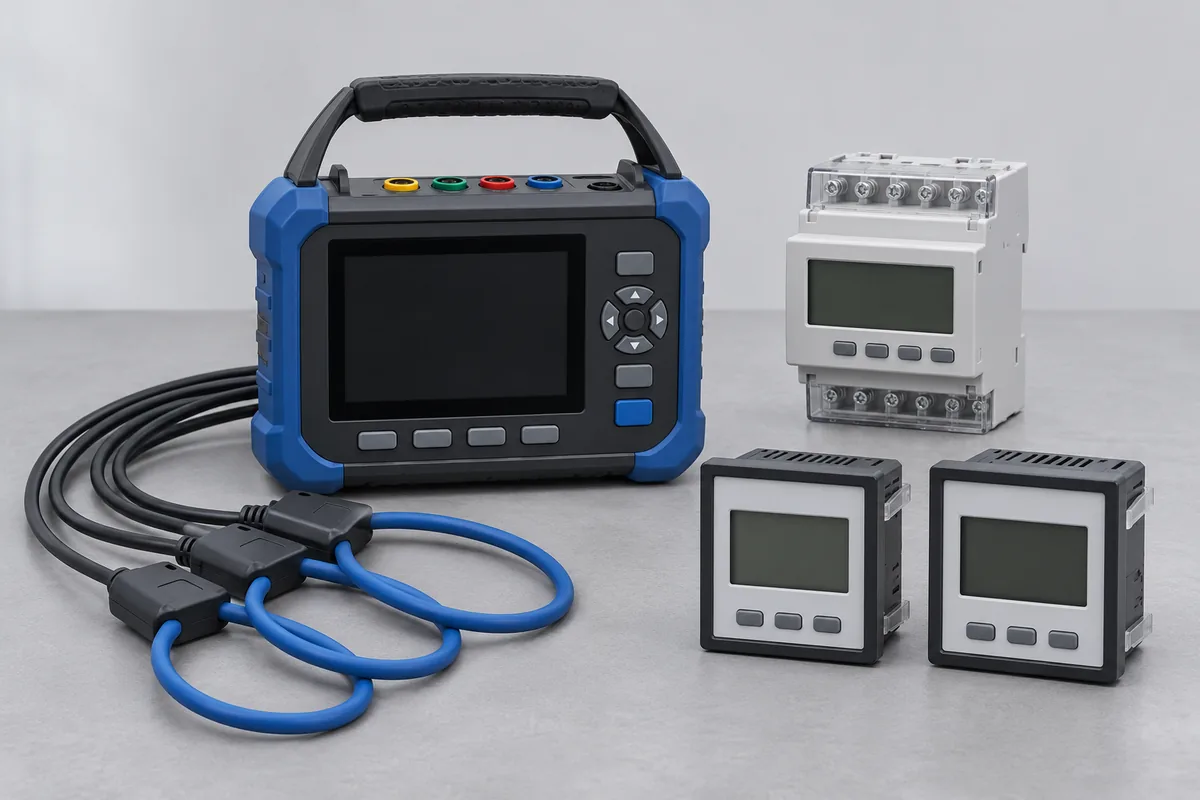
List the measurements your report uses
Separate voltage and current readings from power, phase, frequency or harmonic functions. Give the working ranges and the wiring configuration in your procedure. RTS will review the requested functions before confirming what can be included.
Match each clamp to a channel
Copy the clamp type, ratio and serial number; include flexible sensors and their interface units if used. State whether you need the main unit assessed alone or together with those probes. Keep a channel that has shown a fault identified separately.
Reading a power channel on the certificate
A request for watts needs more detail than a voltage point beside a current point. Give the connection mode, current sensor ratio and the phase or power factor used on your bench. If reports distinguish individual phases, say whether you need a result for each input. An analyzer may also have a separate neutral-current channel.
For harmonic measurements, copy the particular order and quantity from your report. A quotation covering the fundamental alone leaves a different question open from one covering a specified current harmonic. A sample report with the plant name and event data removed can show the required fields.
Wattmeters and dedicated power displays
A standalone wattmeter can use the same voltage, current and phase information needed for an analyzer's power channel. State whether your procedure records active power in watts, reactive power in var, apparent power in volt-amperes or power factor. List each required output separately. Copy the phase arrangement and power factor for each requested point. Include any external sensor or transformer ratio entered into the display.
If the instrument is used on a bench motor test, give the actual working combinations of voltage and current. If it is mounted in a utilities panel, identify the panel and whether the instrument can be released. For a pass or fail statement, supply the acceptance limit and its source. The quotation should name the power function covered so your team can match it to the inspection record.
After a line handover
Identify the owner of the recorder and each probe before arranging a handover. A hired probe may need to return to its supplier while the recorder goes back to the plant. Confirm which items can leave the site together.
Phase meters and the two signals being compared
A phase meter enquiry needs both signal descriptions, not only an angle in degrees. Give the voltage or current inputs, frequency, selected channels and leading or lagging convention used by your procedure. Identify transformers or probes that form part of the comparison. RTS can review the angle result and its reference arrangement separately from an ordinary AC amplitude check; the latter does not establish the phase relationship.
Phase sequence meters
A phase sequence meter may report an order or direction instead of a numerical phase angle. State the indication your maintenance procedure requires and identify any motor-rotation function. Include lead markings and the input conditions from the equipment manual. Ask for the intended functional verification to be named explicitly in the quotation. A phase-sequence indication should not be described as an angle calibration or a certificate for the connected installation.