
On this page
Active area, wavelength and bias
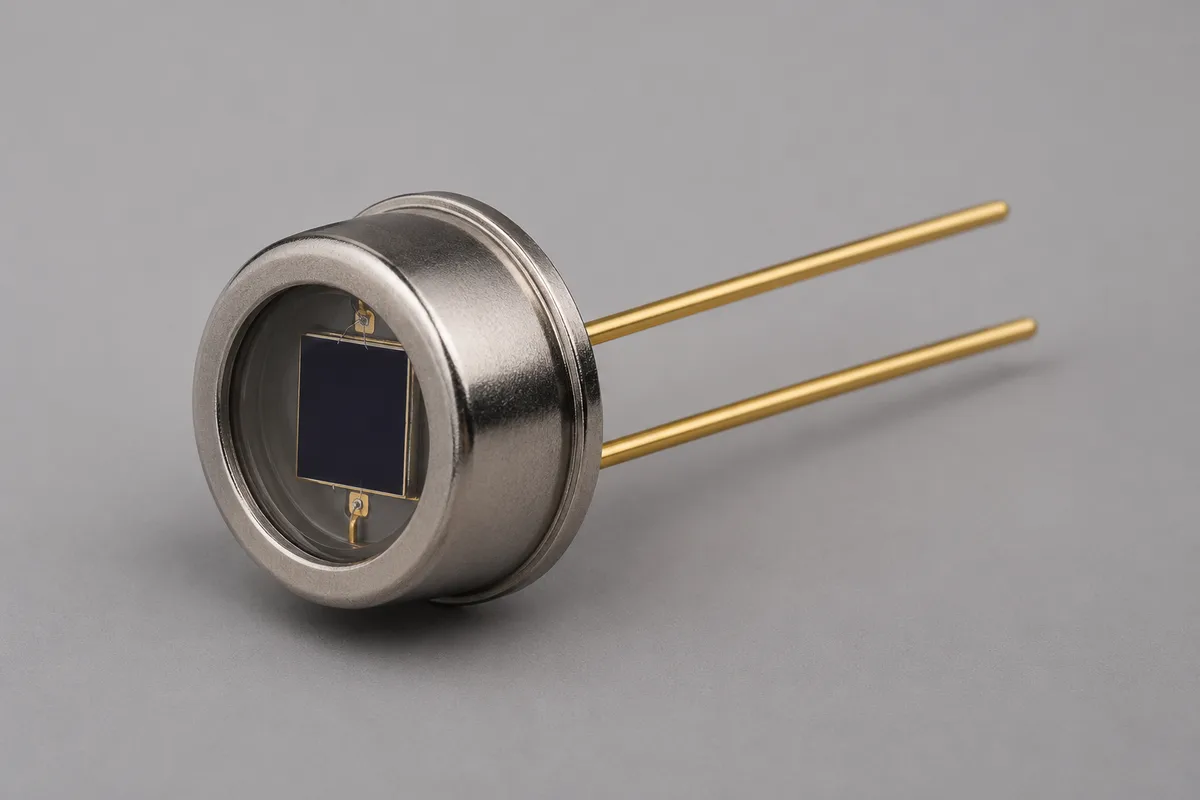
Identify the active area, wavelength range, bias condition and amplifier gain if fitted. Specify whether you need responsivity in current per optical power or a voltage output for the complete assembly. Include any window, filter or fibre connection normally present.
Responsivity in A/W applies at a stated wavelength. A value assigned at one wavelength cannot automatically be used to interpret a reading from a different light source. Note whether your record needs the diode current itself or the voltage produced by the diode and its amplifier together.
Photodiodes as optical reference detectors
Identify the complete assembly, active area, operating conditions and wavelengths for which a response is needed. A single sensitivity number should retain its wavelength and illumination arrangement. Provide previous responsivity data if the detector is a reference. RTS evaluates optical response at the requested wavelengths and records electrical readout checks separately.
Specifications and service checks
A detector producing 0.4 A/W at a specified wavelength would produce a nominal 4 µA from 10 µW at that wavelength in its linear range. Give the wavelength and the amplifier gain when converting a voltage reading back into incident optical power.
- Range and configuration
- Responsivity is expressed in amperes per watt at a stated wavelength. One value cannot describe the detector's response throughout its spectral band.
- Manufacturers and models
- Hamamatsu S1227 is a silicon photodiode family. Active area and spectral response vary with model suffix.
- What we check
- Compare photocurrent under known optical power at the selected wavelengths, with the collection geometry, bias and temperature recorded.
- Reference equipment and accuracy
- Use a calibrated optical detector or optical power reference and low-current readout. Dark current and beam placement affect the low-level comparison.
- When to repeat the check
- Review after optical-window contamination, bias changes or exposure above the detector rating.
Technical references Hamamatsu S1227-series silicon photodiodes