
On this page
From bridge ratio to resistance
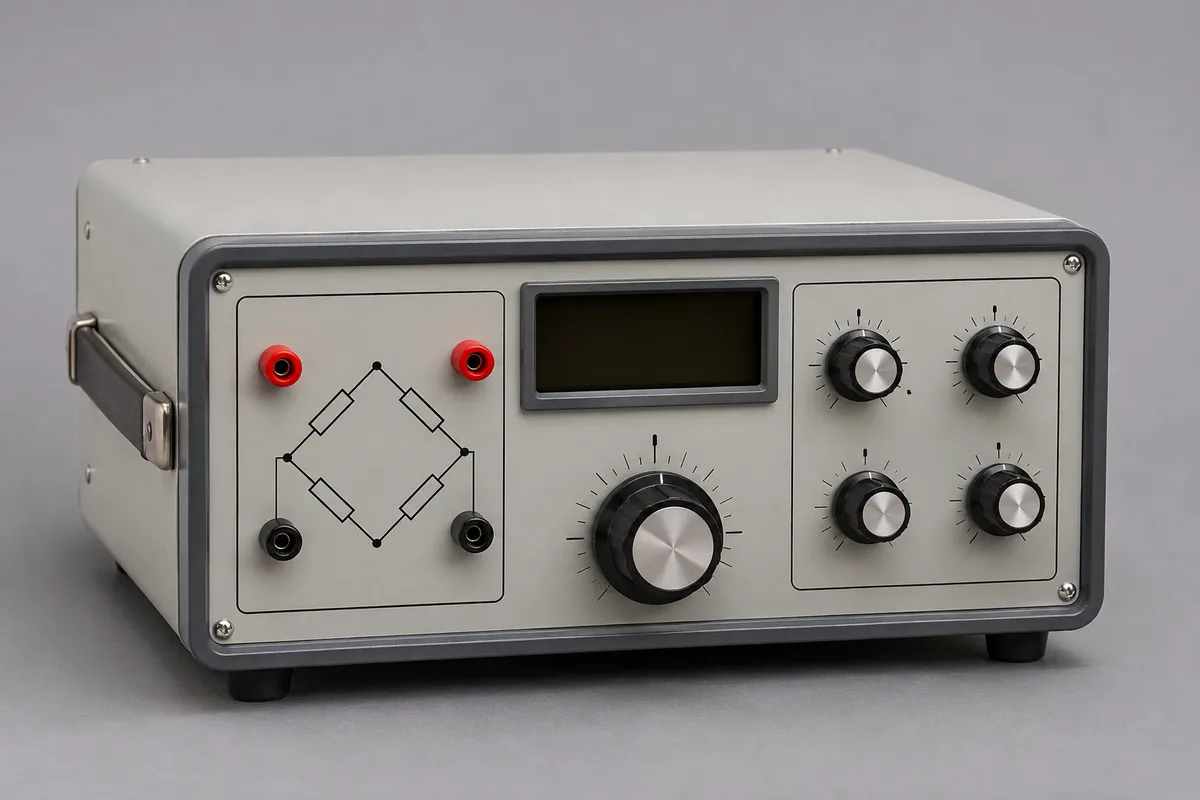
A thermometer bridge can display a ratio against an external reference resistor. Converting that ratio to ohms requires the resistor’s assigned value, which can differ slightly from the nominal value engraved on the case. Send the reference certificate with the desired ratio or resistance range, wiring and test current. For temperature work, tell us whether current reversal is used and the resistance interval of the sensor.
Resistance bridges and comparison measurements
Send the bridge model, circuit or terminal arrangement and the ratio or resistance settings used. Identify the reference resistor, detector and leads that form the normal setup. If the report needs a ratio result, state that explicitly; a resistance reading in ohms does not answer the same question. Keep any reversing or balancing sequence with the procedure supplied for review.
Direct resistance results retain the values, test current and two- or four-wire configuration. The published CC-4643 permanent-facility four-wire entries specify 20–180 ohms for measure on page 8 and 10–100 ohms for source on page 10. Bridge-ratio and micro-ohm work uses its own measurement arrangement. Where a bridge and external standard are used together, retain their identities, prior results and any changed components or connections.
Specifications and service checks
When using a ratio bridge with an external standard, note which arm contains the unknown and which contains the reference. An inverted ratio can yield a plausible number near unity and still lead to an incorrect conversion to ohms.
- Range and configuration
- A reading of 0.5 against a 100 Ω reference represents 50 Ω under the assumed ratio convention. The actual reference value and excitation are part of the result.
- Manufacturers and models
- Isotech microK is a comparison bridge used in precision resistance thermometry. Record whether the bridge indicates resistance or a ratio to an external standard.
- What we check
- Verify ratios using stable combinations of characterised resistors, including ratios close to those used in practice. Retain the temperature and current with the results.
- Reference equipment and accuracy
- Use calibrated reference resistors and a suitable ratio reference or bridge calibrator. Its uncertainties must support the required ratio accuracy.
- When to repeat the check
- Review the bridge and its external standard separately; a shift in either can move the reading.
Technical references Isotech microK comparison bridges