
On this page
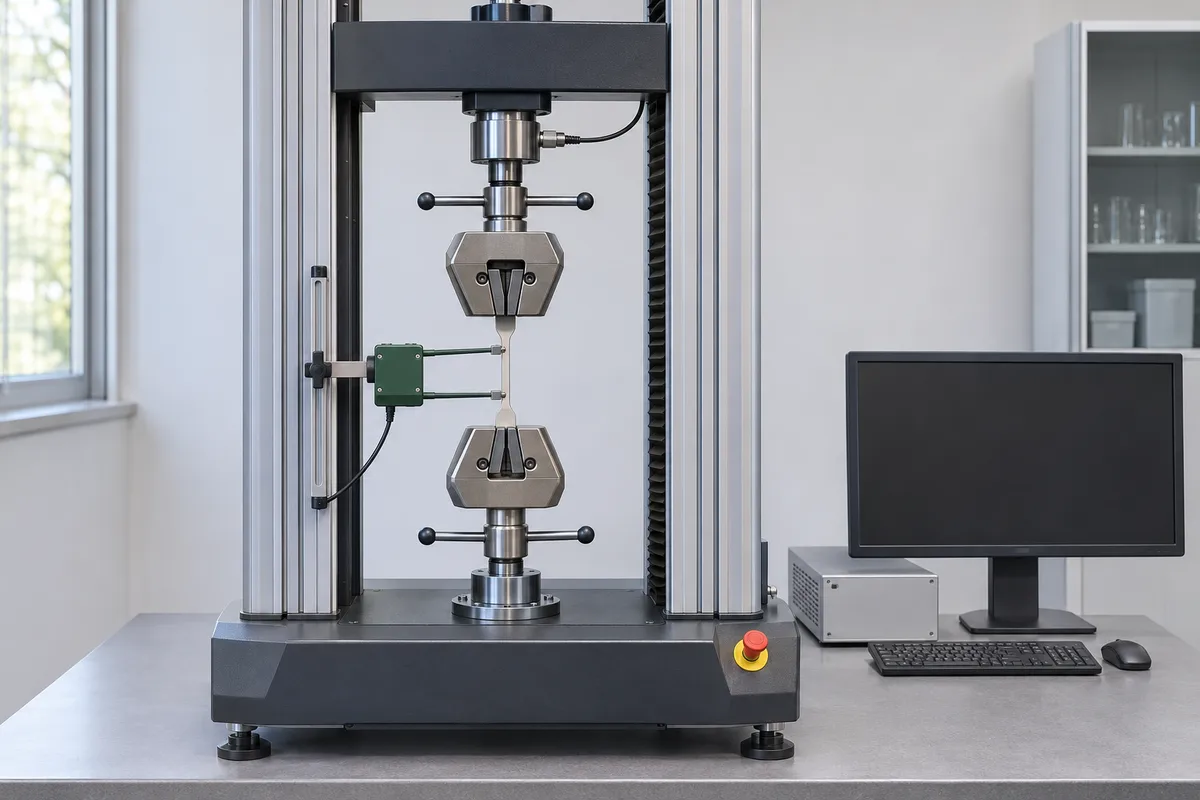
Load cell, grips and force direction
State the working force interval, load cell, grip arrangement and the direction used. If the method uses proof strain or another extension measurement, add the extensometer with its gauge length. Keep the force result with the installed readout channel and its serial number.
A factory may use the same frame for a wire pull and a flat strip test with different cells. Identify both assemblies even if the software prints the same machine name at the top of each test report.
Specifications and service checks
A wire pull test can lose grip before the wire breaks. Keep the force trace and identify the failure location when asking about an unexpectedly low peak. Pulling force calibration and specimen slippage answer different questions.
- Range and configuration
- Instron’s 6800 range includes a 100 kN system. The fitted load cell can have a lower capacity than the frame, and a lower-capacity cell may be used for small specimens.
- Manufacturers and models
- Instron 6800 is a universal testing system family. Identify the particular load cell and whether it is used for tension, compression or both.
- What we check
- Verify tensile force along the axis of the grips with a traceable force-proving device. Identify the load cell, tensile fixtures and lowest force used for results. Add extension checks where the test reports strain.
- Reference equipment and accuracy
- Use a calibrated force-proving device rated and classified for the working forces and direction. Use a displacement standard and time reference where travel or speed is included.
- When to repeat the check
- Review force and extension verification when a load cell, extensometer, grip train or drive component is changed. A check specimen helps reveal changes between calibrations.
Technical references Instron 6800 Series Universal Testing Systems · ISO Force-proving instrument calibration