
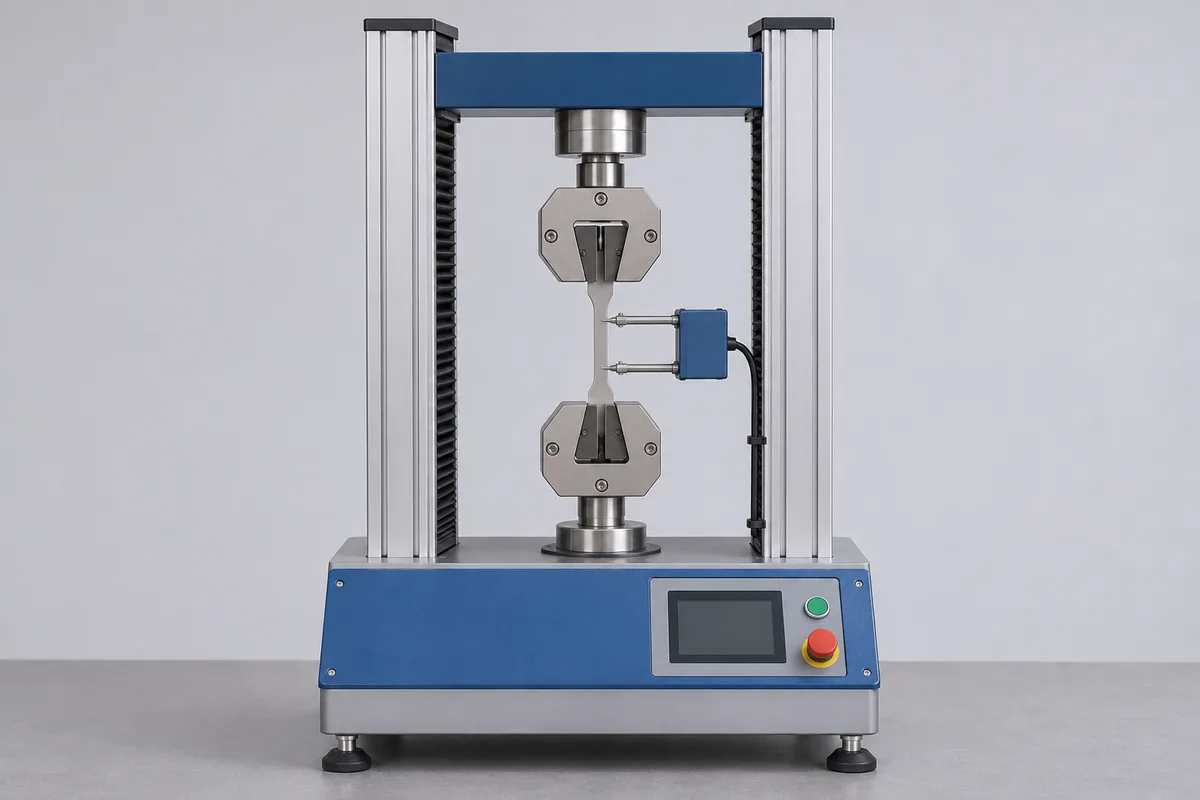
Which force reading goes into the test report?
Identify the frame, force transducer and indicator or software channel that produces the recorded force. Some machines use a lower-capacity cell for lighter samples. Give each cell's rating and the force interval your procedure uses with it. If a previous verification lists separate ranges or classes, attach that part of the record.
State tension, compression or both. A concrete compression machine, for example, might call for a single compression range. A tensile frame with interchangeable grips may need several loading configurations. Include the standard, edition and classification you require so RTS can confirm the available reference forces and fixtures for each direction.
Force, crosshead travel and extension
A material test can record force, crosshead movement and extension from a clip-on extensometer in the same file. Each quantity has its own measuring system. Mark the columns your request covers. If extension or travel also needs checking, give the device ID, working distance or gauge length, and the units shown on the result.
Booking time on the installed frame
Give the clear space between the crosshead and table, the grip or platen details and the plant engineer who can release the machine. A photo with the normal fixtures in place helps establish whether a proving device will fit. For a frame at IMT Kharkhoda, agree access and the production handback time before the test queue is moved.
Fatigue testing machine channels
For a fatigue testing machine, identify the force, displacement or strain channels and the loading programme used. State whether the request concerns static indications, dynamic response or timing and cycle counting. A static force result alone should not be described as verification of the complete cyclic test. The method, reference system and reporting capability for each requested dynamic characteristic need separate review.
Flexural testing machine configuration
Identify the flexural testing machine's force channel, support span, loading arrangement and displacement indication where used. Give the required working loads and specimen method. A force comparison concerns that measuring channel; it does not automatically establish support geometry or the calculation used for a flexural result. Include each required dimension and measurement separately so RTS can review the complete request.
Spring testing machine force and travel
For a spring testing machine, list the force and displacement channels and identify tension or compression operation. State whether the method checks force at a specified length, travel at a load or another relationship. Include the contact fixtures and reference position. A correct force indication does not establish the travel value used to assess the spring, so both quantities must be considered in the enquiry.