
On this page
Which pitch leaves do the inspectors use?
Give the thread series on the holder and the leaves your inspectors use. Let us know whether the check covers spacing, form or both. A pitch leaf helps identify or compare a profile. A go or no-go gauge checks how the finished thread fits.
Thread pitch gauge leaves
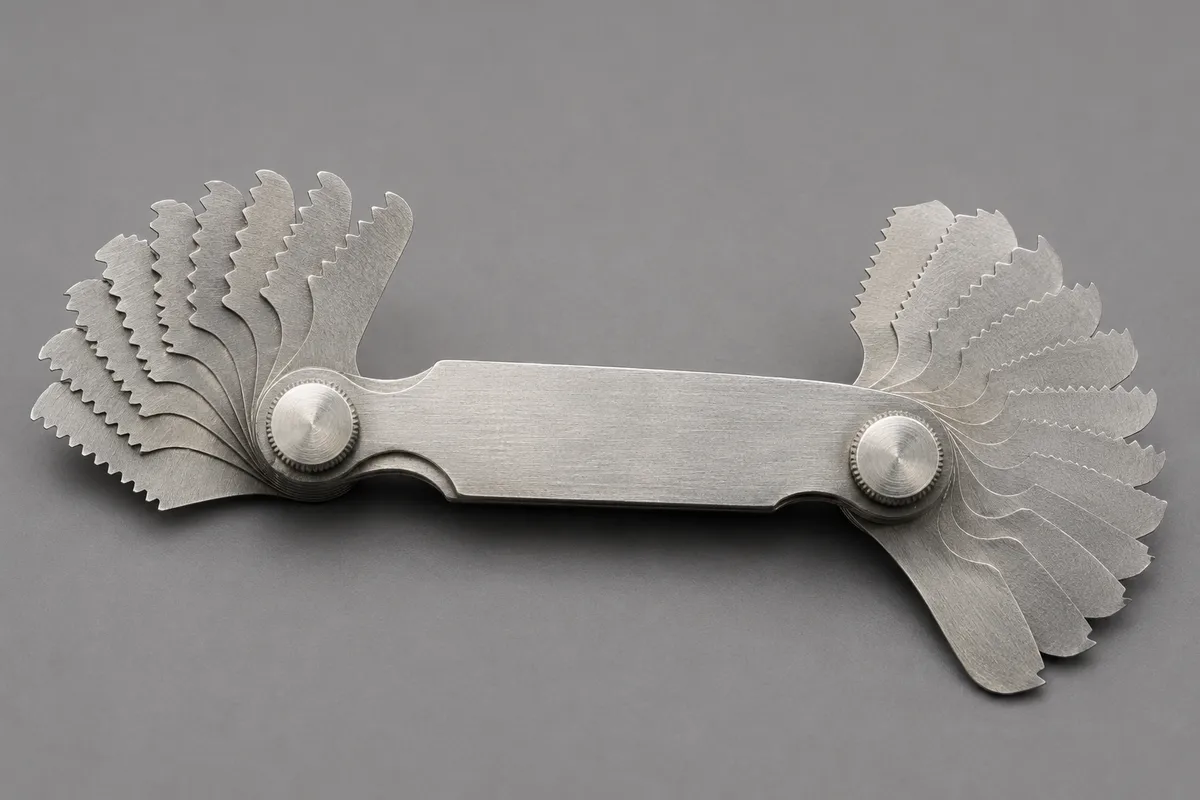
For a folding set, list the leaf markings and state whether the scale gives metric pitch or threads per inch. Include the thread form printed on the holder and a photograph of any leaf that has become difficult to identify. Purchasing can then request selected leaves or the complete set without leaving the quantity open.
A thread-pitch leaf helps identify a thread; finished-thread acceptance also uses the checks specified on the component drawing. Retain the required profile or pitch limits with the leaf's identification. Bent tips or worn teeth should be recorded before comparison, with the leaves kept in their holder to protect the working edges.
Specifications and service checks
An 18 threads-per-inch leaf represents a pitch of about 1.411 mm. It can appear to match a nearby metric pitch across just one or two crests. Check engagement along several teeth and identify which pitch scale the leaf carries.
- Range and configuration
- Starrett’s 159M has 28 leaves covering pitches from 0.5 to 11.5 mm for 60° threads. Inch-series leaves are usually identified by threads per inch.
- Manufacturers and models
- Starrett 159M is a metric screw pitch gauge for comparing thread form.
- What we check
- Verify marked pitch at the working teeth and inspect the flank profile where required. Identify individual leaves so worn teeth can be reported by pitch.
- Reference equipment and accuracy
- Use a calibrated optical measuring system with a traceable length and angle scale. Select magnification for the tooth spacing under examination.
- When to repeat the check
- Inspect working teeth before use. Recheck any leaf that has been bent or reground, and follow historical wear when setting recall.
Technical references Starrett Screw pitch gauges