
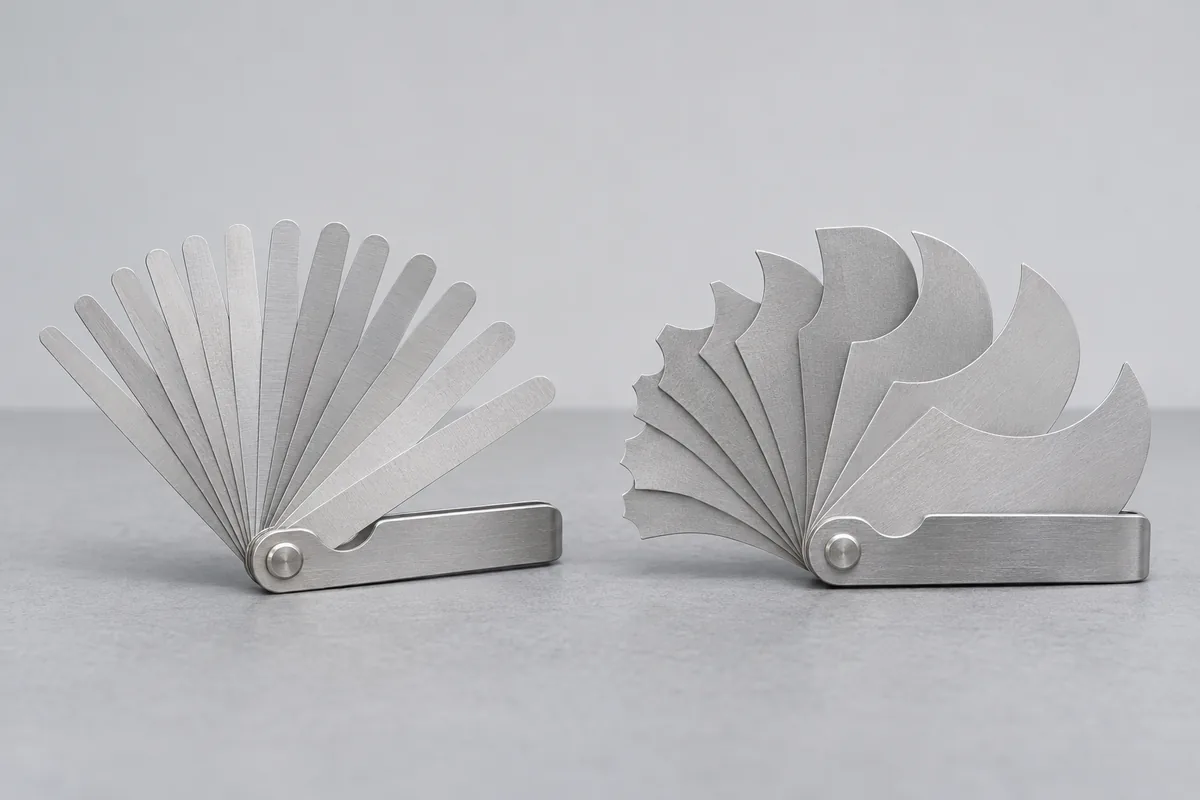
Identify the curved edge you need checked
List the nominal radii and say whether the job uses a concave or convex edge. A toolroom might check the outside corner of a component with one leaf and an internal fillet with another. Mark those as separate entries even when the number stamped on both leaves is the same.
For a special profile made to a drawing, include the drawing revision and the acceptance limits. The laboratory needs enough information to distinguish a standard circular radius from a profile that only resembles one. RTS can then review the comparison and reporting requirement.
Keep the individual leaves traceable
If the leaves stay riveted into one holder, use the set ID and a clear list of the requested leaves. For loose leaves, agree an identification method before dispatch so the report can be matched to the pieces returned. Mention a visibly chipped edge, a bent leaf or a size marking that is difficult to read.
A set used only for selected products may need results for a few radii. Tell us whether purchasing wants that selection or the entire set quoted. Include the unit rather than relying on the inspector recognising the scale.
Returning the set to the inspection station
Put the inspection station or part family on the return list when a shared set passes between shifts. Keep the case and holder with the leaves so the receiver can reconcile the set before releasing it. Note any leaves deliberately excluded from the order alongside those sent for review.