
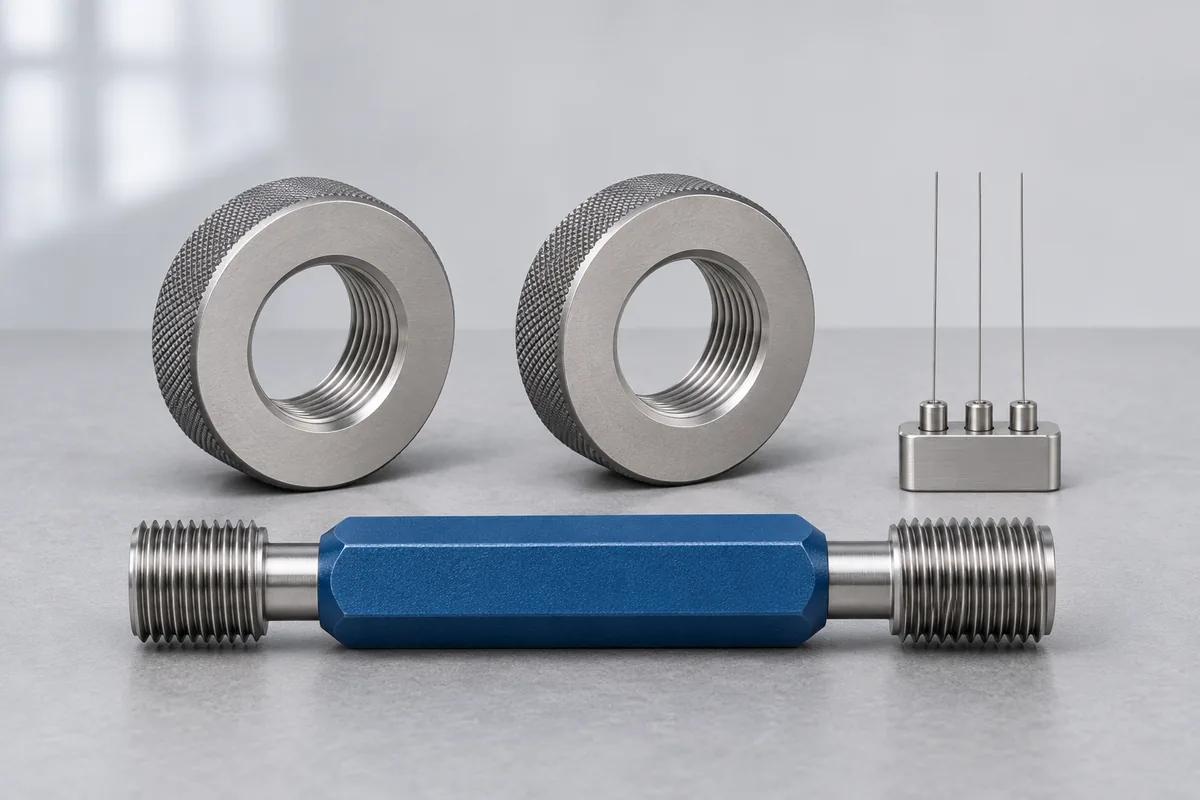
Read both ends of the gauge
Say whether the item is a plug for inspecting an internal thread or a ring for an external thread. For a double-ended plug, identify the GO and NO-GO ends. For separate rings, keep the serial number with the correct ring when filling out the list.
Quote from the thread designation
Give the pitch or threads per inch, tolerance class and thread system from the gauge or drawing. Flag tapered threads, left-hand threads and setting plugs. If a thread ring is adjustable, mention any setting plug normally used with it so RTS can review the pair before you send it.
Thread measuring wires and three-wire sets
A three-wire measurement uses the wire diameters as part of the calculation. List the nominal wire size, number of wires and set identification when asking RTS to review calibration. Keep a matched set together and say how individual wires are distinguished. Include the diameter results or measuring positions required by your inspection procedure, particularly when a set contains spare wires.
The reading taken over the wires also depends on the measuring instrument and the thread geometry. Give the thread form and pitch if you need help defining the request. Ask for the wire results to be identified separately from any calculation for a component. Protect loose wires in their labelled holder, and flag a missing member or a wire replaced since the previous certificate.
Thread pitch gauge leaves
A pitch gauge helps identify the spacing and profile of a thread. For a folding set, list the leaf markings and state whether the scale gives metric pitch or threads per inch. Include the thread form printed on the holder and a photograph of any leaf that has become difficult to identify. Purchasing can then request selected leaves or the complete set without leaving the quantity open.
Explain which result your inspection procedure needs, including any profile or pitch limits. A check of the leaf supports that identification task; acceptance of a finished thread also needs the checks specified on the component drawing. Mention bent tips or worn teeth and keep the holder with the leaves during dispatch. RTS will review the requested comparison and reporting before confirming the work.
Returning a set to inspection
Put the part family, tool owner and return department on the packing list when an inspection set travels through central stores. Keep GO and NO-GO members identified in their cases. List borrowed setting plugs separately so the returned set can be reconciled before it reaches the inspector.