
On this page
Mapping the three axes to the connector
Include the orientation drawing, connector mapping and mounting method. Give the frequency points required for each axis and identify any cable or conditioning unit used as part of the chain. Report cross-axis response separately if required.
A sensor mounted sideways can put the machine’s vertical vibration on the channel stamped X. The certificate still needs to identify the sensor’s X, Y and Z axes. An installation sketch linking those markings to horizontal, vertical and axial channels lets the condition-monitoring team apply the right sensitivity to each trace.
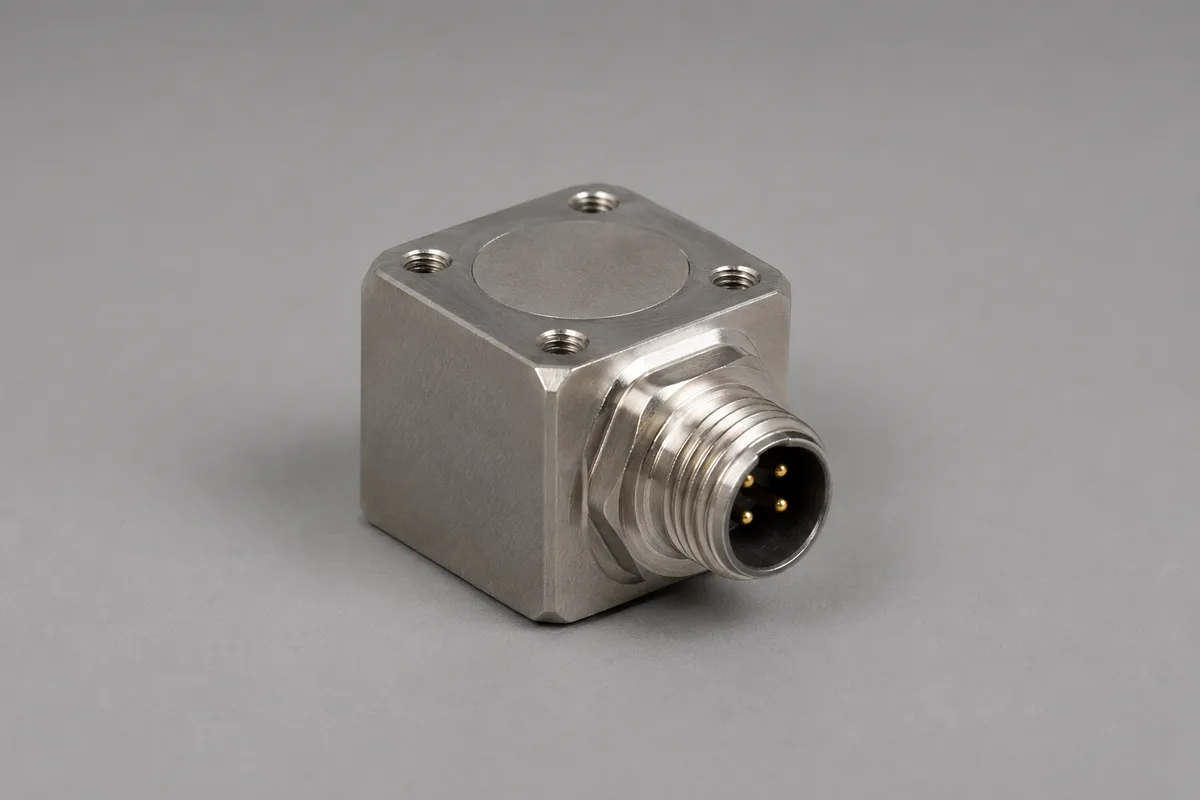
Triaxial accelerometers
Retain the connector pinout and axis convention used by the recording system. A result for one axis should not be copied into the other channels. Identify mounting adapters separately and request that the accepted configuration is recorded, so the returned results can be assigned to the correct directions in your software.
Specifications and service checks
On a fixture that tests three directions in turn, a large signal on the wrong trace can come from interchanged cable labels. A mapping of sensor axes to recorder channels makes an axis-specific sensitivity check meaningful after cables have been replaced.
- Range and configuration
- Specify sensitivity and the required frequency band independently for X, Y and Z. A single nominal sensitivity does not establish all three responses.
- Manufacturers and models
- PCB Piezotronics 356A32 is a triaxial example with three separate outputs. Identify axes as marked on the sensor.
- What we check
- Compare each axis against reference acceleration in its sensitive direction. Cross-axis response, where needed, is a separate measurement.
- Reference equipment and accuracy
- Use a calibrated reference accelerometer and vibration exciter, with suitable fixtures and signal conditioning. Orientation and transverse movement contribute to uncertainty.
- When to repeat the check
- Reassess all affected axes after a drop or sensor repair. Trend sensitivity separately for each axis.
Technical references PCB Piezotronics 356A32 data sheet