
On this page
Trigger levels for each timing mode
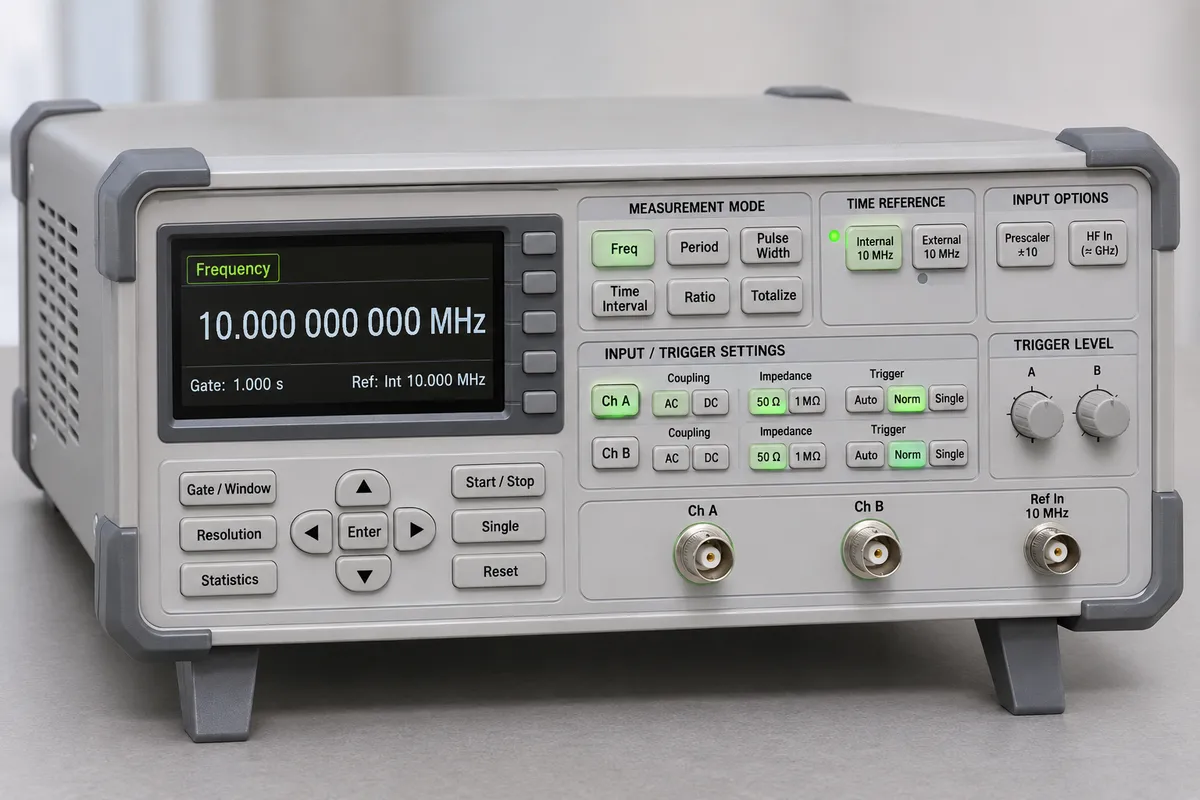
Identify the modes in routine use, input channels and trigger settings. Give the internal or external time reference and any prescaler or high-frequency input option. Specify measurement conditions for each function you expect to find on the result sheet.
For a repetitive square wave, period is the reciprocal of frequency. Pulse width, however, depends on duty cycle as well. A counter can therefore give a correct period result without having exercised the edge or threshold settings used for a pulse-width check.
Specifications and service checks
If a counter accepts an external frequency reference, its front-panel indication may come from the internal oscillator on one bench and the shared reference on another. Record which reference was selected during the disputed measurement and whether the indicator showed lock.
- Range and configuration
- For a periodic signal at 1 MHz, one period is 1 µs. Interval measurements between two channels also depend on trigger levels and path delay.
- Manufacturers and models
- Keysight 53230A is a universal frequency counter and timer. The selected channels, input options and timebase determine the measurement setup.
- What we check
- Compare frequency readings with a reference signal; for time intervals use defined edge pairs and check the channel combination used in service.
- Reference equipment and accuracy
- Use an independent calibrated frequency reference and suitable time-interval source. Account for trigger uncertainty and channel skew at short intervals.
- When to repeat the check
- Track the internal timebase separately from checks made while locked to an external reference.
Technical references Frequency Counters: 53230A