
On this page
Reading the stem
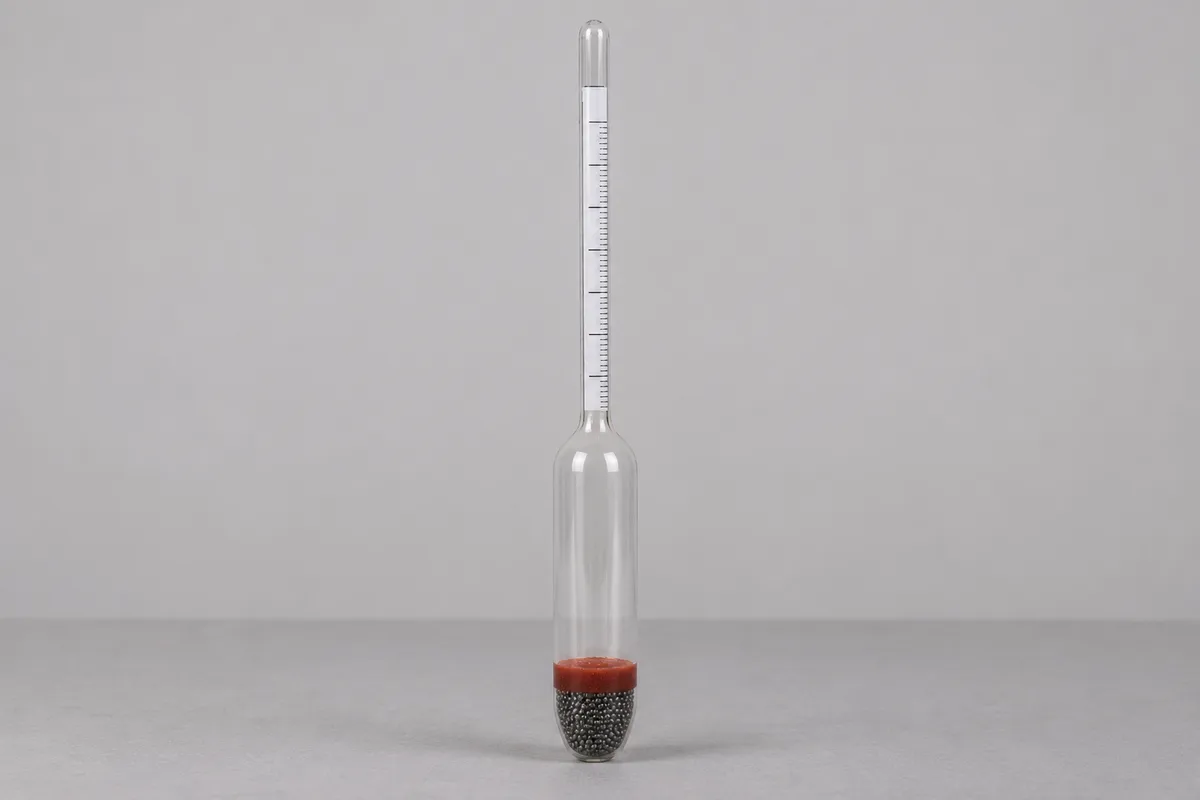
Send a clear photograph of the graduations and the temperature marked on the instrument. For a relative density hydrometer, include both reference temperatures if the scale gives a pair. With a lactometer or alcoholmeter, retain the actual scale designation. A value copied from the middle of the stem can mean quite different things on two instruments.
Liquid surface and reading point
The liquid rises or falls against the stem. The reading taken where the level surface would meet the scale can differ from one taken at the top of that curved surface. Record the convention used in your process, especially with an opaque sample. Liquid surface tension also affects how the hydrometer floats, so tell RTS what liquid or product family you normally measure.
Selecting marks for the report
A result at the middle of a wide scale may be of little use when production accepts material within a narrow band. Give us the upper and lower limits your laboratory applies and the smallest division on the stem. Where two hydrometers overlap, include both instrument IDs. A correction for the first stem cannot simply be entered against the second.
Equipment covered
Density hydrometer
Copy the density unit as printed on the stem. A result expressed in kilograms per cubic metre is easy to misread if the instrument register drops the unit and retains only the figures.
A hydrometer that sits close to the wall of a narrow cylinder may touch the wall as it settles. Identifying the vessel diameter and usual sample volume gives context to a complaint that changes when the same liquid is moved to another cylinder.
- Range and configuration
- Density in kg/m³ and relative density are different scales. Quote the stem markings, calibration temperature and meniscus convention.
- Manufacturers and models
- Brannan's S-series specific-gravity hydrometers divide the span into individual ranges, including 0.60–0.65 and 1.95–2.00.
- What we check
- Compare selected graduations in liquids of known density at controlled temperature. Read the instrument freely floating and account for the specified meniscus convention.
- Reference equipment and accuracy
- Use calibrated density standards or an independent reference density determination, with a thermometer adequate for the liquid's temperature coefficient.
- When to repeat the check
- Inspect the paper scale and glass before use. Movement of ballast or the scale calls for a new comparison.
Technical references General Purpose Specific Gravity Hydrometer S Series - Brannan
Hydrometer
For a case containing overlapping hydrometers, photograph the numbers on the individual stems. A result labelled only with the outer case number can be hard to match to the float that was used.
A clear sample and an opaque sample may require different meniscus-reading conventions. Tell the bench which convention your procedure uses and which is marked for the instrument. A difference of one graduation can otherwise look like drift across different operators.
- Range and configuration
- Read the unit and reference temperature on the stem. A specific-gravity value of 1.000 is a density ratio under stated conditions; a value in kg/m³ is an absolute density.
Shared with Density hydrometer — Manufacturers and models · What we check · Reference equipment and accuracy · When to repeat the check · Technical references