
On this page
Force at the specified spring height
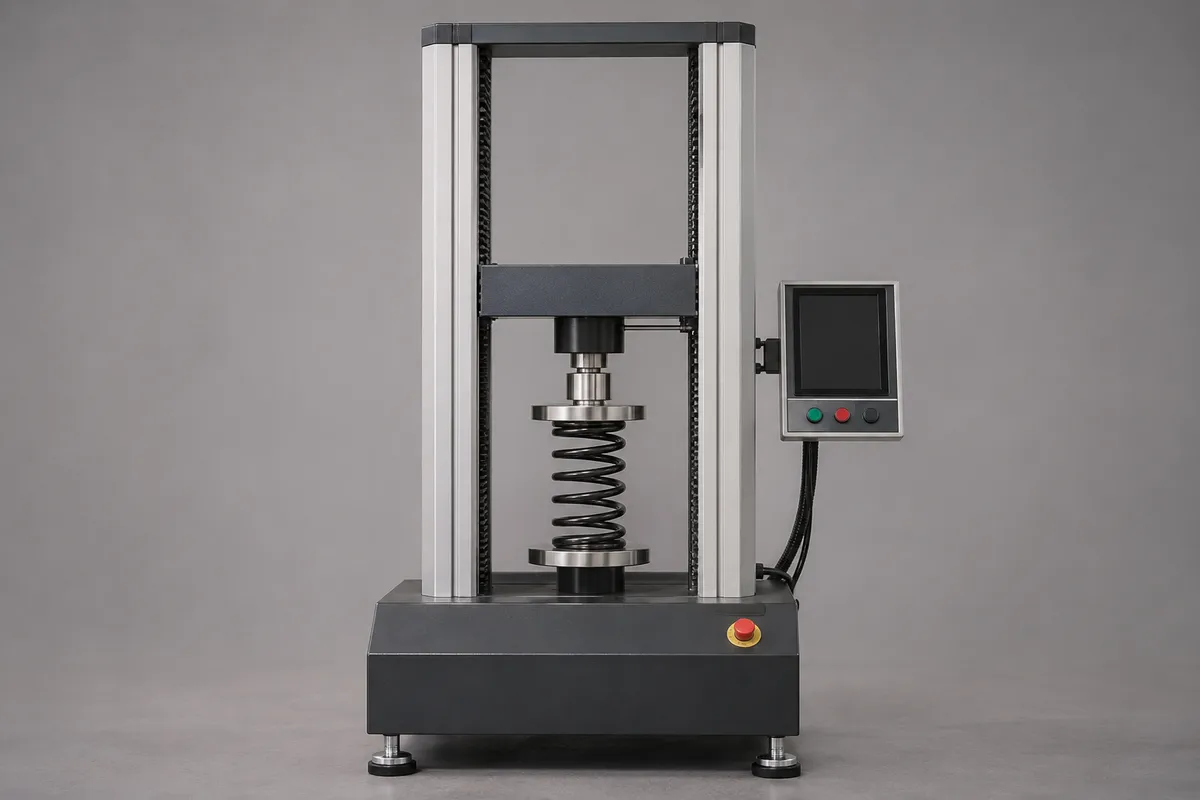
Give the free and working heights or extensions, preload where used, and force points from the spring drawing. Identify whether the machine has compression platens, tension hooks or both. Request the length channel as well as the force channel if both are used to calculate spring rate.
Spring testing machine force and travel
The specified relationship may be force at a length, travel at a load or another combination defined by the method. Contact fixtures and the reference position are recorded with both channels. These results let the laboratory evaluate the spring using measured force and travel values from the same arrangement.
Specifications and service checks
A spring measuring 30 N at 20 mm height and 50 N at 15 mm height changes force by 20 N over 5 mm. Its average rate over that interval is 4 N/mm. Both specified heights are needed for that comparison.
- Range and configuration
- Larson offers ECT testers with 110, 200, 750 and 1,500 lbf capacities and a standard 5 inch stroke. The job may require force at a height or spring rate between two positions.
- Manufacturers and models
- Larson Systems ECT is an example of a force-and-length spring tester.
- What we check
- Check force and travel separately, then verify the combination at the height settings used for production. A rate calculation needs two reliable force readings and their displacement difference.
- Reference equipment and accuracy
- Use a calibrated force reference and length or displacement reference. Include fixture compression and platen alignment where they affect the working height.
- When to repeat the check
- Verify again after changing a load cell, platen or height stop. A stable working spring can be trended between calibrations but should have its own history.
Technical references Larson Systems ECT Spring Tester