
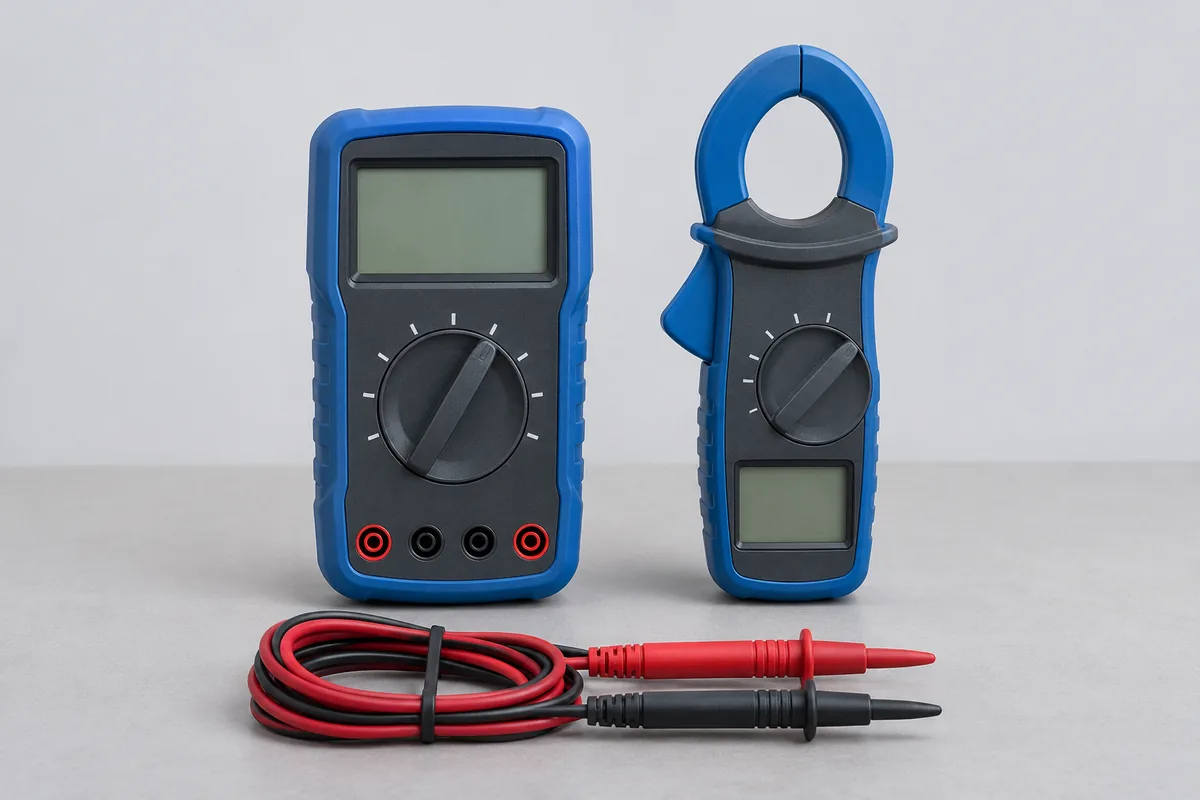
Describe the current clamp
Tell us whether the jaws are part of the meter, a removable probe or a flexible loop. Give the model, AC or DC current range, and the frequency where specified. For an external probe, include its output ratio and the meter it feeds.
Include the functions used with leads
If the instrument is also used for voltage or resistance, list the functions and working points you want covered. A request for current through the jaws alone gives the team a different scope from one that includes the input sockets.
What the jaws actually enclose
On a motor feeder an electrician might use the clamp around a single conductor. A maintenance team investigating leakage may use a different jaw or range to read a much smaller residual current. Two entries simply marked “current” could describe either job. Give the lowest working current in its actual unit, the range position and whether AC or DC is used.
With a detachable flexible loop, the head and readout may each have a range selector. A photograph of both settings helps identify the scale factor. Keep any extension between the head and the display with that assembly.
Match the probe to the display
Where several probes fit one display, label the pairings and include each serial number. Mention an intermittent display or jaws that fail to close completely before the unit is sent in.