
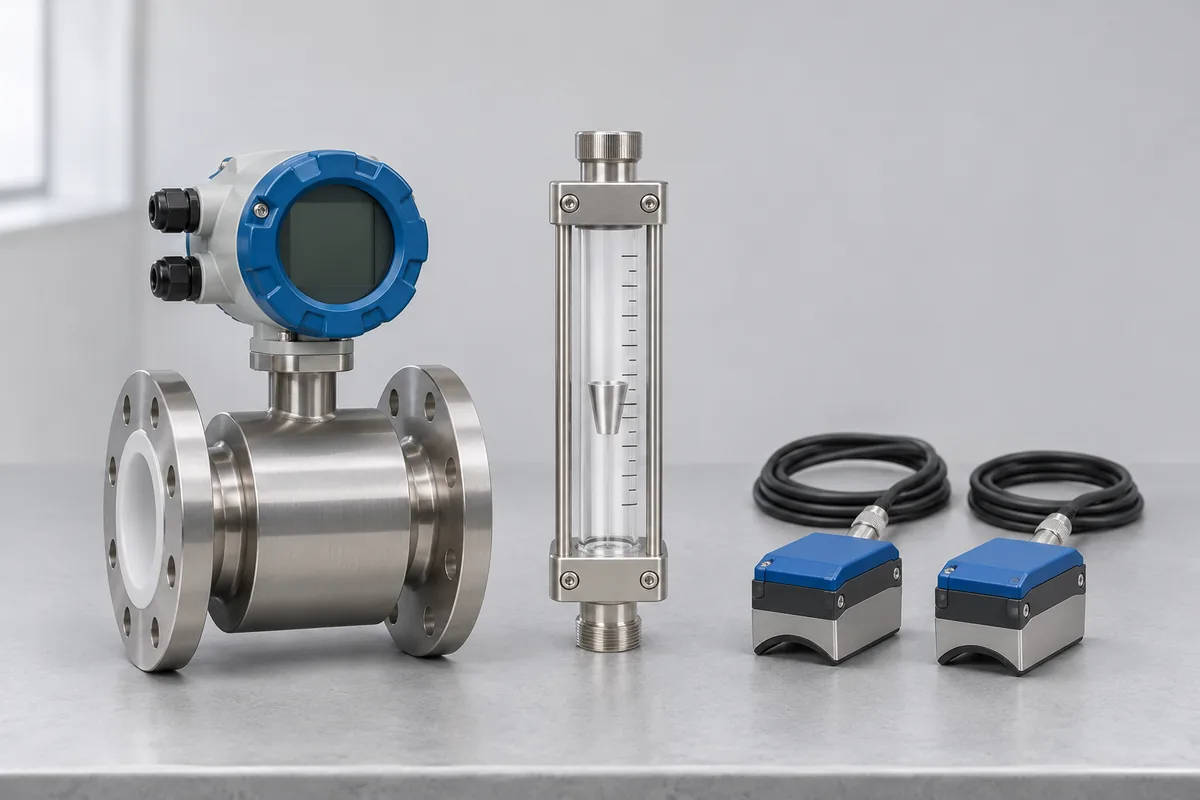
Gas flow meters and reference conditions
For a gas flow meter, name the gas and its composition where it is a mixture. Include the operating pressure and temperature, the flow interval and the units on the display. State whether the result represents actual volume, volume referred to specified conditions or mass flow. If the display uses normal or standard volume units, provide the reference temperature and pressure used by your process; those labels alone are insufficient.
Identify any density or gas selection configured in the meter and include the manufacturer’s method requirements. A meter checked with one gas should not automatically be treated as verified for every other gas. RTS will review the medium, reference arrangement and feasibility before confirming a job. For an installed utility meter, name the plant team responsible for isolation and recommissioning.
What passes through the meter?
Identify the technology if known, the pipe or tube size, the direction of flow and the fluid normally present. Include the working interval and units. For a variable-area meter, say how the float is read; for an electronic meter, say whether the reading comes from its display, pulses or another output.
Installed meter or removable unit?
Give the meter and converter identities where they are separate. Report any access restriction and process residue before arranging removal or transport. RTS will review the medium, available reference and operating range before agreeing on an on-site or laboratory job.
Arrange the utility outage
For an IMT Faridabad installation, identify the line owner and the period during which flow can be interrupted. A national request covering several meters should give the actual plant and medium against every tag.
Flow calibrators used as references
For a flow calibrator, identify the medium, flow direction, units and reference conditions used to express the result. Include the inlet and outlet arrangement and any pressure or temperature sensors forming the reference system. Source and measurement functions should have separate point lists. RTS will review the method and capability for the actual medium; a calibration entry for pressure alone does not establish flow-calibrator coverage.
Flow indicators and scaling
A flow indicator may receive an electrical signal from a separate sensor. Give the input type, displayed units, scaling and any square-root or totalising function. State whether you need an input simulation or a comparison using actual flow through the connected meter. Those results have different boundaries. Keep the sensor identity and configured range with the indicator so the enquiry does not treat a display check as a complete flow-system calibration.
Flow nozzles as primary elements
A flow nozzle is a primary element with geometry and installation conditions that affect the inferred flow. Provide its drawing, throat dimensions, material and the intended fluid conditions. Distinguish dimensional verification from a flow-coefficient determination and from calibration of the connected differential-pressure transmitter. Each requires its own method. RTS can review the stated requirement and available service route before the nozzle or installed assembly is accepted.
Flow switch operating points
For a flow switch, record the medium, pipe or connection size, installation orientation and the required switching point. State whether both operation and reset are to be observed and identify the contact or output used. A continuity check confirms a contact state, not the flow at which it changes. RTS must review the flow reference and arrangement before agreeing a switching test for the actual instrument.
Flow transmitters and the sensing element
A flow transmitter can be separate from its sensor or integrated with it. List both identities, the signal output, configured span and any density or temperature compensation settings. Ask whether the requested result covers the electronics alone or the complete assembly with flowing medium. Include the application fluid and relevant operating conditions. This lets RTS review the correct method rather than assign a full flow result to an electrical simulation.
Orifice plates and the requested result
For an orifice plate, supply the drawing revision, bore, pipe internal diameter, plate construction and pressure-tapping arrangement. Mark the dimensions that need results and retain the installation orientation. A dimensional report for the plate is separate from a calibrated discharge coefficient or an installed flow-system result. RTS should review the intended method and tolerance before quoting the item as a primary-element enquiry.
Fuel dispenser measurement enquiries
A fuel dispenser enquiry needs the product, delivery-volume points, meter or nozzle identities and the conditions under which the readings are required. Separate a technical measurement comparison from any official approval, sealing or verification process requested by your organisation. Send the exact requirement before a visit is arranged. RTS must review the equipment, reference measure, site conditions and service route; this page does not promise a statutory verification service.