
Which reference is fitted?
Copy each module's range, unit and serial number. Say whether its reading is gauge, absolute or differential. Describe the permitted medium and the connection, including any adapter kept with the module. For a controller, identify the outlet and the working pressure settings.
Keep electrical functions separate
A pressure value and a current reading may appear side by side when checking a transmitter. If both need results, include the mA function and its working points separately. A leak complaint is also a different request from a reference reading comparison.
Reading the reference module label
A case may hold a low-range module for a differential transmitter and a second module for a line gauge. Each can have its own serial number, pressure convention and connection. List the working points under the module they belong to and preserve the marking for gauge, absolute or differential pressure. A value of zero does not describe the same physical condition for each.
If the handheld unit also records a loop current, give the current points on a separate line. Identify whether purchasing needs evidence for the plug-in module, the electrical readout or a result for their combined use.
Two modules, one calibrator case
A maintenance team at IMT Faridabad can release a low-pressure module while retaining the high-pressure one. Mark the module due for work instead of listing only the serial number of the carrying unit.
Ball valves in a pressure test assembly
A ball valve is normally an isolation component in the pressure setup, rather than an indicating instrument. Identify its material, connection, rating and the test assembly it belongs to. If you need leakage, pressure integrity or operating checks, name those requirements separately for review. Include the valve on the accessory list when it affects the agreed measurement connection; do not request a numerical calibration certificate without a defined quantity.
Check valves and flow direction
A check valve controls the permitted flow direction in a pressure or flow assembly. Mark that direction and give the model, connections and specified operating conditions. If the enquiry concerns opening pressure or reverse leakage, provide the manufacturer's requirement and acceptance limit. Those need an agreed test arrangement. Listing a check valve alongside a gauge does not mean that the gauge calibration also establishes the valve's performance.
Needle valves used for pressure control
A needle valve may help the operator adjust or isolate a pressure point without providing a measured value of its own. Record where it sits in the circuit and which reference instrument reads the pressure. Describe any requested shut-off or leakage evaluation separately. For calibration work, include it as an identified accessory only where the agreed setup requires it, with the rating and medium available for compatibility review.
Pressure gauge syphons
A pressure gauge syphon belongs to the installation arrangement between the process and gauge. Record its construction, connection and the service in which it is used. State whether the gauge will be checked with the syphon attached or removed, and identify the required pressure reference level. A gauge result alone does not certify the accessory's mechanical condition or suitability for the process; those questions need separate assessment.
Pressure snubbers
A pressure snubber changes how pressure fluctuations reach the instrument. Identify its model, adjustment position if applicable and where it sits in the line. A steady-pressure calibration and a check of dynamic response are different requests. Tell RTS whether the snubber must remain in the agreed assembly and keep it identifiable. Any response or blockage assessment should be described separately from the gauge's indicated-pressure results.
Valve manifolds
A valve manifold should be listed with its port diagram, valve functions and the transmitter or gauge it serves. Identify the connection used for the proposed pressure comparison. A manifold can be part of that arrangement without being a separately calibrated measuring instrument. Provide any leakage or pressure-integrity requirement as a distinct test enquiry, and leave the operating configuration to the responsible plant team when arranging a site visit.
Hand pressure pumps
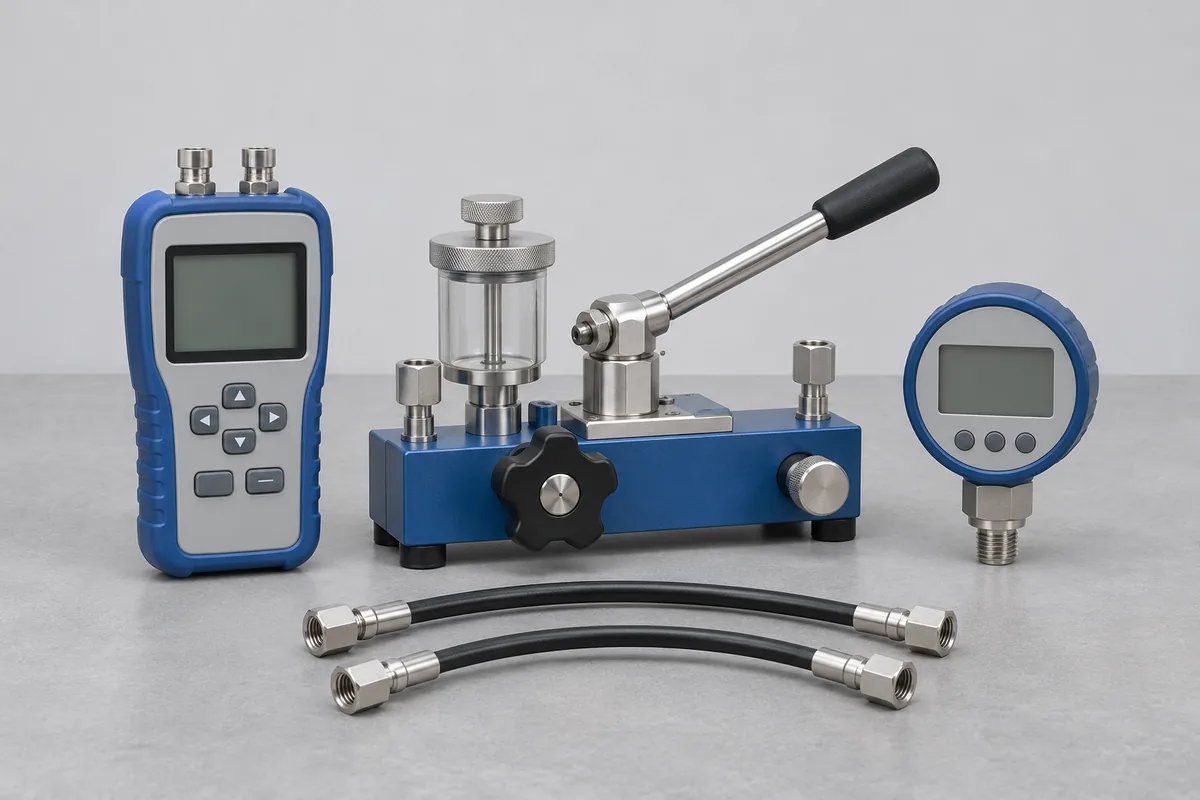
A hand pressure pump generates pressure for a comparison but usually relies on a separate reference to measure it. Identify the pump, medium, connections and the reference gauge used with the kit. If you require a maximum-pressure, stability or leakage observation, describe it as a defined check. Include the pump as an accessory where needed; do not treat the act of generating pressure as a calibrated numerical indication.
Pressure regulators
A pressure regulator sets or controls pressure and may be supplied with a separate gauge. Identify inlet conditions, outlet range, medium and the flow condition at which performance is required. A gauge calibration is different from a regulation or pressure-drop test. RTS can review the specific measurements and apparatus needed before accepting the regulator; a setting on its control is not automatically an independently calibrated pressure value.