
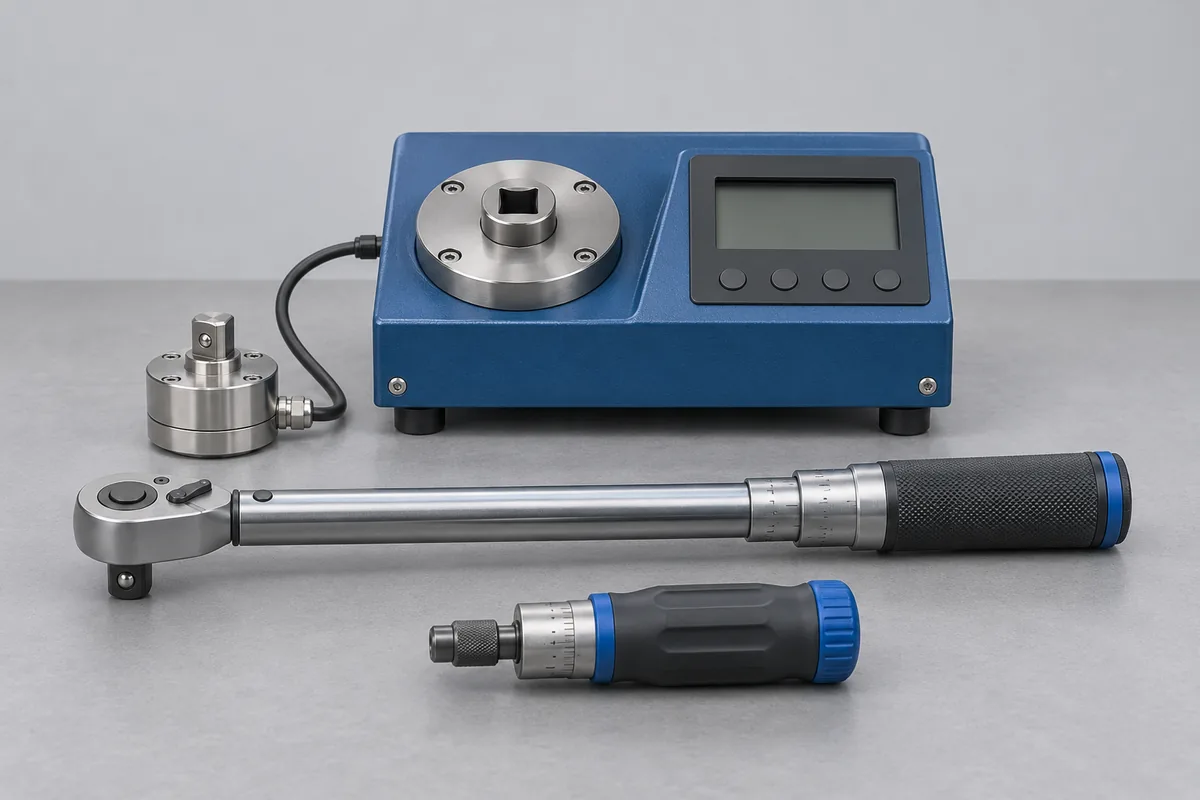
Identify the wrench and its head
Include the model, drive size and marked range. Say how the wrench indicates torque, for example by a click, pointer or digital display. For an interchangeable head, give its part number and describe the head normally fitted.
Specify direction and units
List the torque settings and whether the tool is loaded clockwise, anticlockwise or both. Keep N·m, lbf·ft and other markings as written. If you use a preset wrench without a scale, include its assigned setting and asset number.
Read the unit on the assembly drawing
A torque setting entered as “20” on a tool list can mean several different things. Copy the unit from the assembly drawing, then the unit engraved on the wrench. If the operator uses a removable head, identify it by part number or give the distance from its locating point to the drive centre. A different head can change how the same tool applies torque.
Where one wrench is used on several stations, group their settings under its serial number. Ask for readings in the directions those stations use and agree whether adjustment is permitted before the as-found results have been recorded.
Agree what happens if a setting is out
Tell us if you need the readings recorded before anyone changes the setting. If adjustment needs approval from your quality team, put that instruction and the approval contact on the enquiry.
Ratchet wrench or torque tool?
A ratchet wrench may simply turn a fastener without measuring or setting torque. Send the model and identify any torque indication, release mechanism or controlled setting. If none is present, define the actual inspection requirement rather than asking for routine torque calibration. A ratchet head fitted to a torque tool should be identified as part of that tool's measurement configuration.
Torque multiplier input and output
For a torque multiplier, provide the model, nominal ratio, drive arrangement and required direction of operation. State whether the result needed concerns input torque, output torque or the assembled system. A nominal multiplication ratio should not be used as a measured output value without the specified assessment. RTS must confirm suitable loading fixtures, references and method before accepting this specialist configuration.