
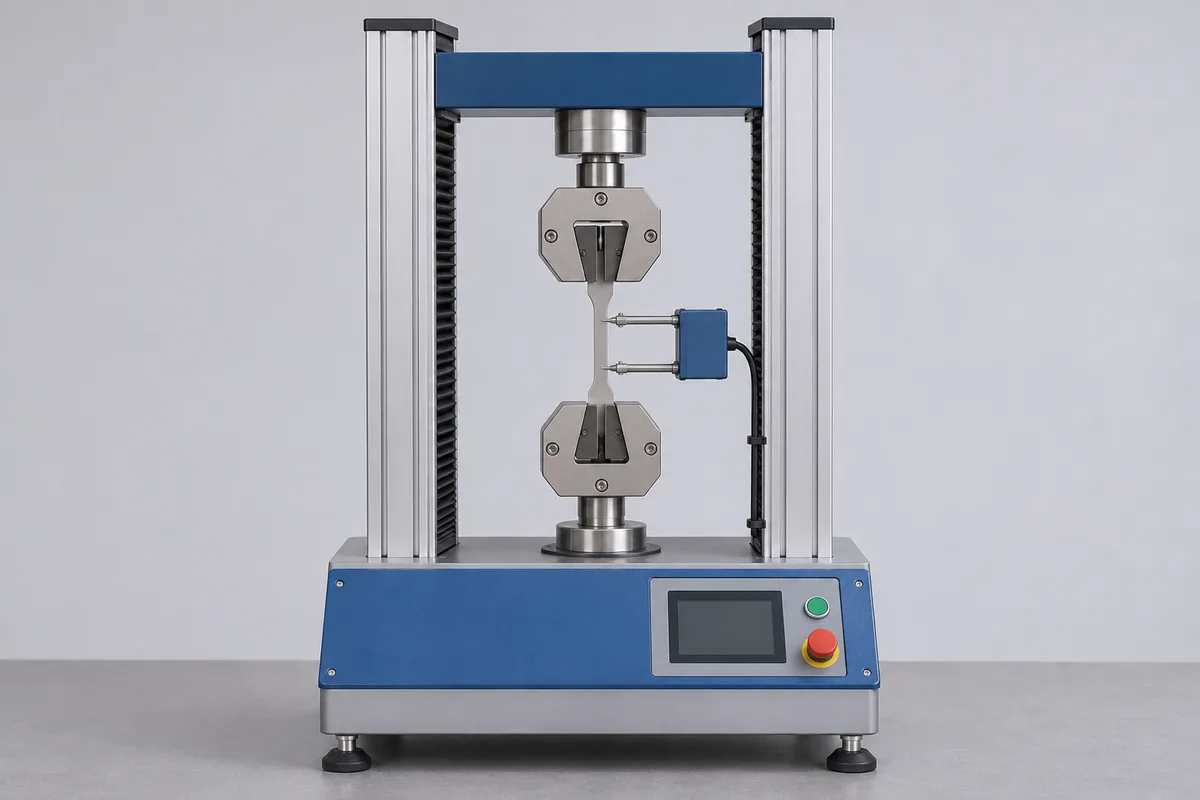
Record gauge length and displacement
Give the manufacturer, model, serial number, nominal gauge length and working travel. State whether the result is displayed as displacement or strain. If your procedure uses more than one gauge length, list each configuration rather than choosing one value to represent all tests.
For a clip-on unit, describe the contact edges and the way it attaches to the specimen. For a non-contact device, identify the optical arrangement and the software version relevant to the measurement. RTS can review whether the proposed setup and reporting requirement can be accommodated.
Keep the readout in the request
An extensometer with a separate conditioner or amplifier should be identified alongside that component. Record the machine channel and any scaling used to convert the signal. Say whether you need the complete installed channel assessed or results for a removable device.
Attach the method and class required by the laboratory's test procedure, together with the displacement points of interest. If the original readings need to be retained before an adjustment, include that instruction on the order and name the person who can authorise the work.
Arrange access to the test frame
Give the machine reference and a period when the frame and its operator are available. If the extensometer can travel, confirm which leads and mounting pieces accompany it. Protect the contacts in their fitted case and list their condition before packing. Include any gauge-length setting piece that belongs with the instrument.