
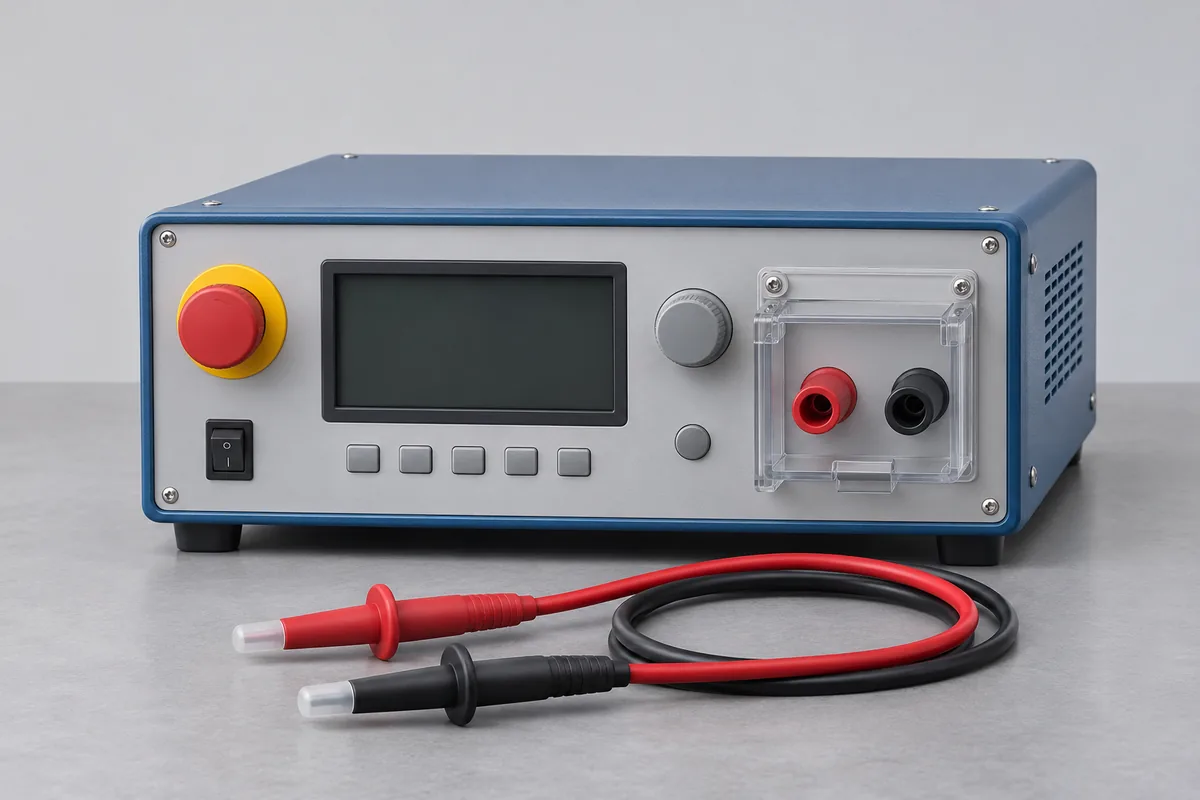
Copy the settings from the approved test instruction
State whether the recipe uses an AC or DC output and give the requested voltage points. Include frequency for an AC output where it is specified. List leakage-current indication, current thresholds and timing as separate requirements. Some instruments combine withstand, insulation resistance and ground-bond functions. Mark only the functions your order needs.
A unit used on more than one product may have several stored recipes. For example, one line might use a different hold time from a second line sharing the same tester. Send both requirements with their product or station references so the quotation can describe the intended checks.
Identify the test set and its accessories
Include the serial number of the main unit, output ratings and any external scanner or switching fixture that forms part of the arrangement. A service manual reference can help identify the manufacturer's provisions for calibration. Have the responsible electrical team arrange access and release. Use existing records and photographs when discussing a fault or unusual reading.
RTS can review the requested measurements before confirming a method and location. Calibration of the tester and a withstand test on a product are separate jobs. If the order concerns a transformer oil breakdown tester, identify it by its own model and function so the enquiry can be reviewed correctly.
Release from the production station
Give the tester asset tag and the engineer who can release it from the assembly station. Identify what remains with the fixture and what travels with the unit. Agree the receiving contact and the results required before the tester returns to production.
High voltage dividers and their matched readouts
A high voltage divider may be an external reference rather than a complete indicating instrument. Identify the divider ratio, rated input, AC or DC use and the readout or load connected to its low-voltage output. Include cable identity and previous assigned ratio values. Any ratio or voltage-dependence evaluation requires a suitable specific method; the presence of ordinary voltage entries in CC-4643 does not establish high-voltage divider coverage.
High voltage probes
Keep a high voltage probe paired with its specified readout and input impedance when describing the measurement. Give the attenuation setting, connector, voltage type and requested frequency if applicable. A probe alone and the probe-plus-meter combination are separate report options. RTS should review the ratings and method before accepting the assembly. Identify this as a probe enquiry rather than assuming the meter's own calibration covers its external attachment.
High voltage sources
For a high voltage source, list the actual output points, AC or DC mode, polarity and intended load. Identify external dividers, monitoring meters and interlocks as separate parts of the system. A successful output indication is not proof of delivered voltage accuracy. RTS must first confirm whether the required method and facility are available; the 50 Hz AC entries in the published scope do not imply unrestricted high-voltage source capability.