
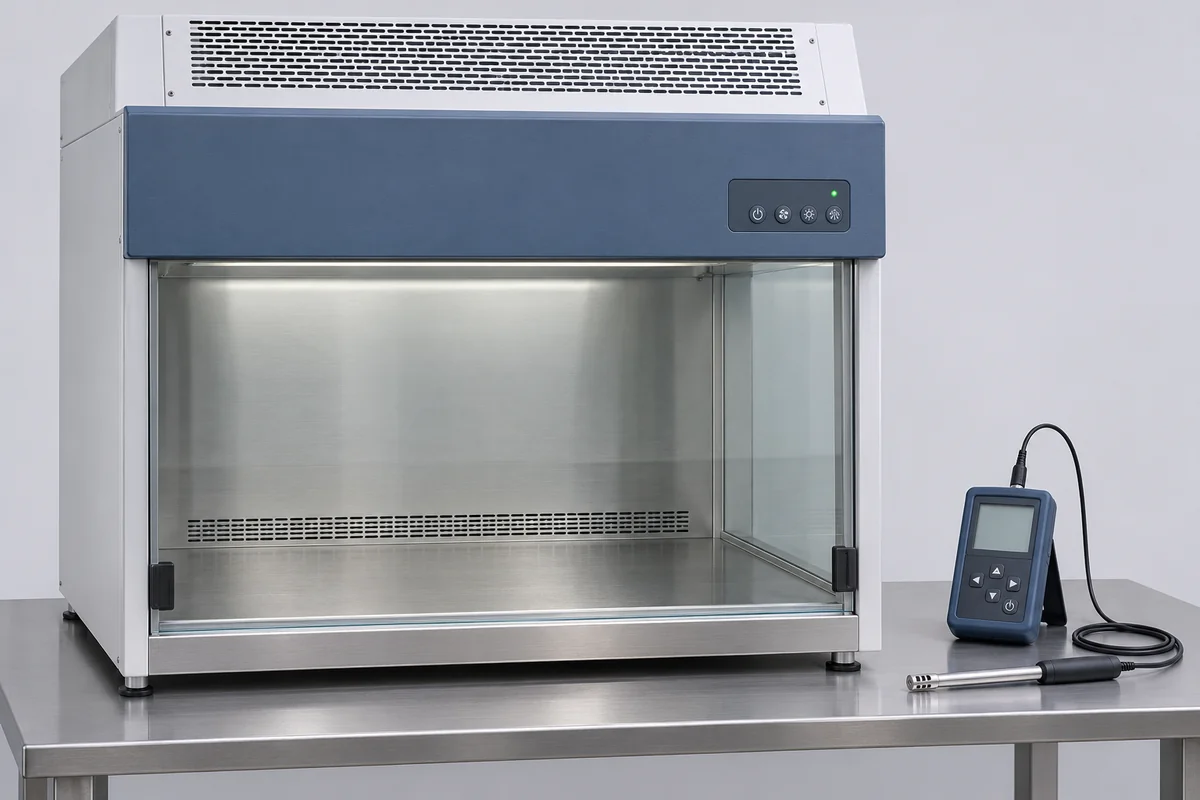
Biosafety cabinet (biological safety cabinet)
A biosafety cabinet, also called a biological safety cabinet, must be identified by its class, type, exhaust connection and installed configuration. Send the previous field report and the tests required by the facility's responsible specialist. Airflow readings, filter-integrity checks and containment evaluation are separate parts of that request. RTS must review the competent service route and agreed protocol before booking; a calibrated airflow instrument does not constitute certification of the cabinet.
Clean benches and laminar air flow cabinets
A clean bench or laminar air flow cabinet is generally arranged to protect the work from airborne contamination. Record horizontal or vertical flow, filter layout, working area and the conditions required for the assessment. Do not substitute a biosafety-cabinet protocol solely because both enclosures have filters. Provide the manufacturer's requirements and intended tests so RTS can review the appropriate measurements and reporting boundary for the installed unit.
Fume hoods and the extraction arrangement
A fume hood enquiry should identify the duct or filtration arrangement, sash position and operating configuration. Give the required airflow or containment assessment and the facility's acceptance criteria. A single face-velocity reading does not describe every containment condition. RTS must review the requested procedure and service capability with the site before work is accepted, including how changes to room ventilation will be recorded during the assessment.
Define the installed operating condition
Send the room layout and relevant supply or exhaust connections with the enclosure identity. Identify the sash or opening position, installed equipment and operating state to be used during assessment. Changes to surrounding ventilation or the work surface should be recorded. The site owner needs to agree which condition represents normal use before a technician begins collecting measurements against the selected protocol.
Keep qualification separate from instrument calibration
A qualification report may contain several observations and measured quantities. Calibrated reference instruments support those measurements, but their certificates do not certify the enclosure by themselves. Give RTS the current procedure and requested test list for a capability review. The quotation should state the competent service route, accepted tasks and reporting limits before any visit, with the facility's responsible specialist retaining authority over release for use.
Prepare a useful handover for the visit
Provide previous results, changes since the last assessment and the contact responsible for the enclosure. Agree access and preparation with the site team, including any decontamination or permit requirements identified by that team. Keep the final configuration and unresolved observations with the report. If the unit is moved or its exhaust arrangement changes, those records help explain why the earlier assessment may no longer describe the installed condition.
Name the acceptance criteria
Attach the protocol revision and identify which results need decisions against limits. A request for a general hood certificate leaves the measurement plan unclear. Agree the applicable checks and report language before the order is raised, so purchasing and the facility owner request the same work.
Aerosol generator in a filter test setup
An aerosol generator supplies a challenge aerosol for a defined test; it is not the detector that measures the response. Give its model, specified aerosol material and the downstream measurement arrangement. Identify any flow or concentration quantity that actually needs a result. RTS can review the generator’s role and requested checks without describing every generator as a routine calibration instrument.
UV lamp and irradiance measurements
A UV lamp is a source, while a radiometer measures its output under specified conditions. Identify the lamp type, required spectral response, measurement position and the purpose of the engineering check. Lamp operating time alone is not an irradiance result. Ask for the suitable specialist method to be reviewed; a lamp check does not by itself establish a validated decontamination process.