
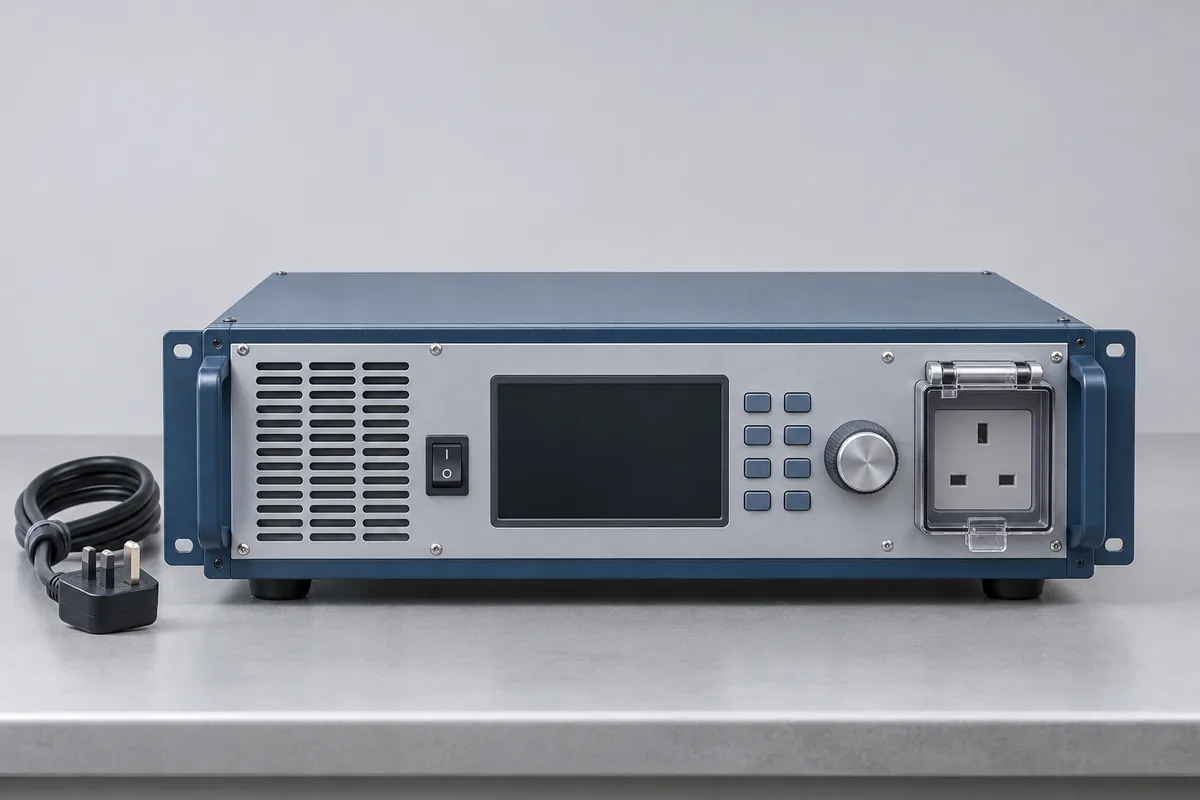
Describe the supply condition used by the bench
Give the number of phases, rated output and the voltage-frequency combinations in the work instruction. State the load condition that accompanies each point. If the bench uses a three-phase output, identify whether the voltage is specified between phases or between a phase and neutral. Copy any phase relationship required by the procedure.
For an AC/DC source, mark the modes used on the order. A DC output point has a different requirement from an AC waveform at a stated frequency. A quotation can be reviewed against both when they are itemised.
Which programmed functions need comparison?
Some production tests use a steady output throughout a run. Others call for a voltage change, frequency change or a timed interruption. If a programmed sequence is part of your requirement, send the relevant sequence settings and identify the result your test report uses. Avoid reducing a sequence request to the source's maximum voltage alone.
A front-panel current or power reading may need its own comparison. Tell RTS whether measurements are taken at the output terminals or at a remote fixture, and include any sense arrangement named in the bench procedure. The team can confirm the requested functions and feasible setup before the job is accepted.
Removing the source from a rack
Record the rack position and the cables or interface modules that belong to this source. Give the available release period and the person responsible for reconnecting it. For a heavier unit, agree collection and handling details with RTS before booking a carrier.
Inverters and output conditions
An inverter enquiry needs the input supply, output mode, frequency and load conditions used on the job. Indicate whether the request concerns the output waveform, voltage indication, frequency or efficiency calculation. A selected output voltage alone does not define the test. RTS should review the complete arrangement and required method before booking; the published AC entries at 50 Hz do not cover every waveform or operating frequency an inverter can produce.
Variac and manually variable AC supplies
For a Variac, identify the variable transformer, any built-in meter and the output terminals used. Give the supply condition, requested output points and load arrangement. A dial position is an adjustment setting unless its relationship to delivered voltage is part of an agreed measurement. List the external reference or indicator separately, and ask RTS to confirm the specific voltage checks rather than treating the whole assembly as a multifunction calibrator.