
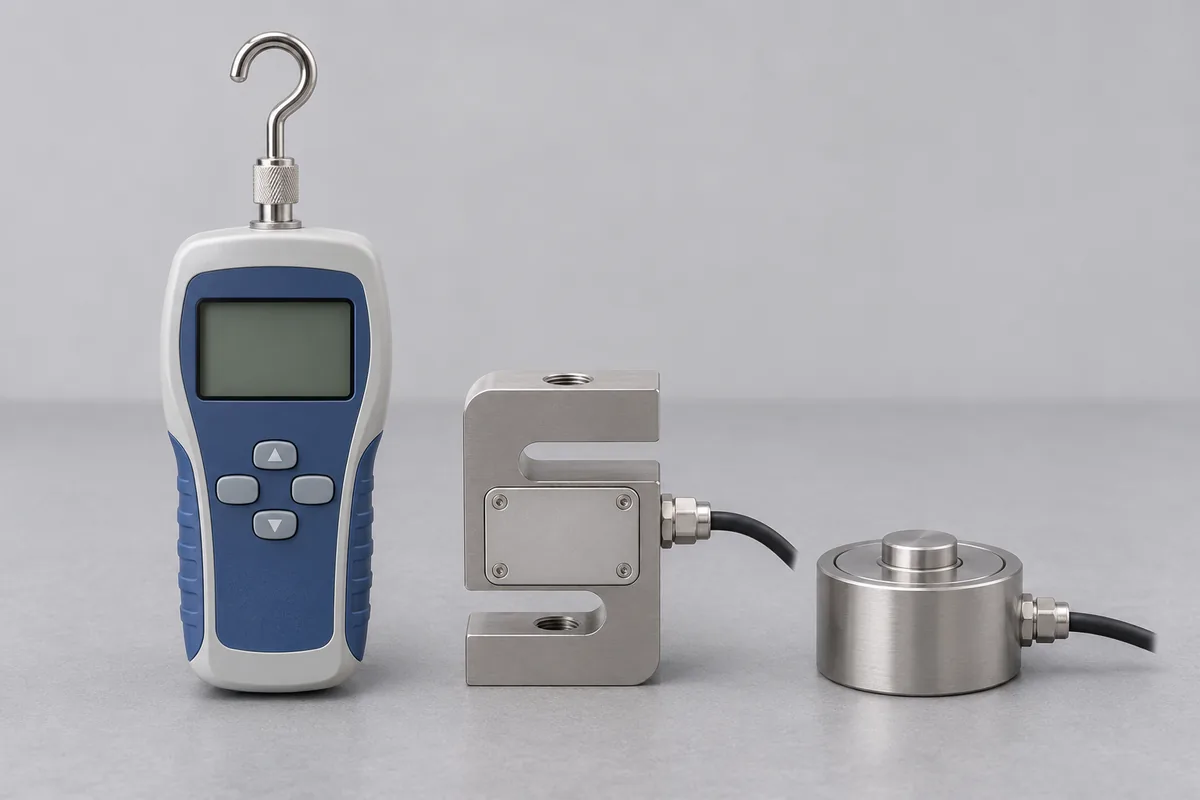
Identify the measuring assembly
Record the model, capacity, unit and smallest displayed increment. For a separate sensor and display, include both identifiers and the cable used between them. Name the attachment: a flat compression foot, hook or threaded fitting may need different handling.
Specify routine loads
List the forces that determine acceptance and say whether your team reads a steady value or retains a peak. If the gauge serves both directions, supply points for each. RTS will confirm the available range and fixture arrangement before booking.
Compression on a stand and tension on a hook
Consider a gauge mounted on a test stand for a push test and later used by hand on a pull handle. Both jobs may use newtons, but the direction, attachment and useful working range differ. A simple sketch of each setup helps identify whether both directions belong on the report.
For a gauge with a peak-hold function, say whether the inspector records a steady force or the highest reading during an event. Static comparison points and the response during a fast event are different requests. The quotation can state which requirement it covers.
Keeping fixtures with a line gauge
An IMT Manesar tool crib may retain a custom fixture while releasing the gauge. Mark which parts can leave together and whether you want results for the gauge alone or with that fixture.
Dynamometer measured quantity
Dynamometer can refer to a force device or a system used to assess rotating machinery. Give the actual model, sensor, displayed quantity and unit. For a force instrument, identify tension or compression and the loading attachments. If the system measures torque, speed or calculated power, list those channels separately. RTS needs the configuration before confirming a measurement route rather than assuming every dynamometer is a force gauge.
Force indicator and paired sensor
Identify the force indicator and the load cell normally connected to it, including the cable and configuration record. Say whether the request concerns the assembled force measurement or only the indicator's electrical response to an input. Those arrangements do not produce the same evidence. Keep any stored sensitivity or correction values traceable to the sensor used for the agreed result.
Tension gauge material and geometry
For a tension gauge, specify whether it senses a direct axial force or measures tension through contact with a wire, belt or strip. Identify the material, size and contact arrangement where the method depends on them. Give the working range and units. A result using one reference material or geometry should not be assumed to cover a different product without review of the measuring principle.