
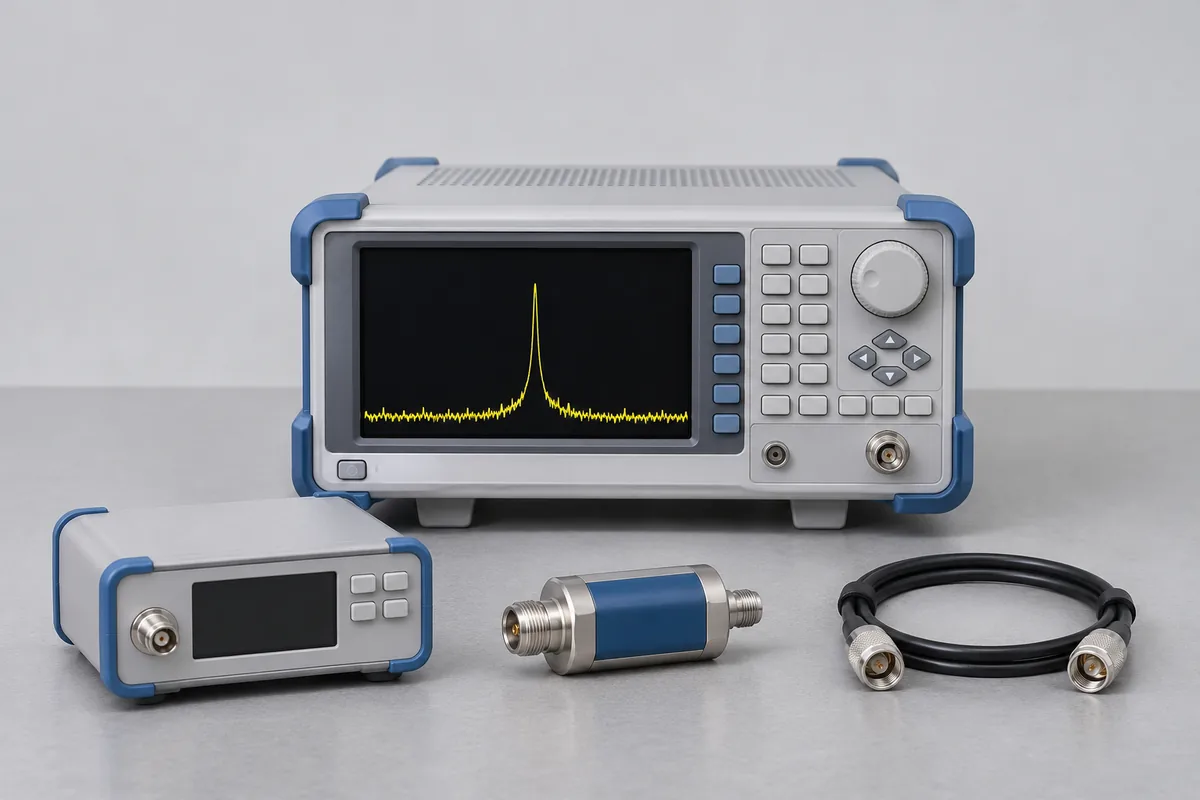
Identify the input path and fitted options
Send the complete model, serial number, frequency options and input connector details. Include an external mixer or other input accessory where used. For a signal analyzer with additional measurement applications, name the application and the quantity you need reported. A fitted option does not automatically place every measurement within one quotation.
Provide the frequencies and signal levels relevant to your work. Include the reference level, attenuation and preamplifier state when your procedure specifies them. If the bench uses an external frequency reference, identify its source and say whether the analyzer will be assessed with that reference or its internal timebase.
Separate the requested measurement characteristics
Resolution bandwidth, amplitude response and frequency accuracy are different entries on an analyzer's specification. Copy the characteristics and settings needed for your test report. A specialist request for phase noise or another analysis function also needs its test conditions and acceptance requirement reviewed.
An internal alignment or a check against a built-in reference is useful operational information, but it does not describe all requested external comparisons. Send a previous result sheet when repeating an established scope. RTS will review the model, options and required conditions before confirming which measurements can be included.
Preserve the bench settings
Keep a copy of approved instrument settings with your equipment record. Identify removable adapters and the person who can answer configuration questions. Give the available release period and receiving address. Existing fault messages or damaged input connectors should be reported before arranging calibration.
EMI test receivers
An EMI test receiver needs the measurement band, detector modes, bandwidth settings and input arrangement recorded. List preamplifiers, attenuators or external mixers used during the required checks. Receiver performance must be reviewed against its own verification procedure, not inferred from a generic spectrum trace. Send the options and required results to RTS before acceptance; checking this instrument does not establish the compliance of products subsequently tested with it.
Measuring receivers and test receivers
A measuring receiver or test receiver may be used for level, modulation or selective frequency measurements. Identify which functions the asset performs and retain the selected detector, bandwidth and reference settings. Include a sample of the result sheet your team needs, without production data. RTS can review that measurement list and the necessary references before quoting; the receiver's model name alone is not enough to define a calibration.
Phase noise analyzers
For a phase noise analyzer, give the carrier frequency, offset-frequency points and the reported quantity. Identify the reference source, channels and any correlation or averaging settings used by your procedure. A carrier-frequency check does not establish the noise result. Send the manufacturer's verification method for technical review, with the required uncertainty or acceptance limits, so the enquiry remains specific to the analyzer's intended use.