
Name the working combination
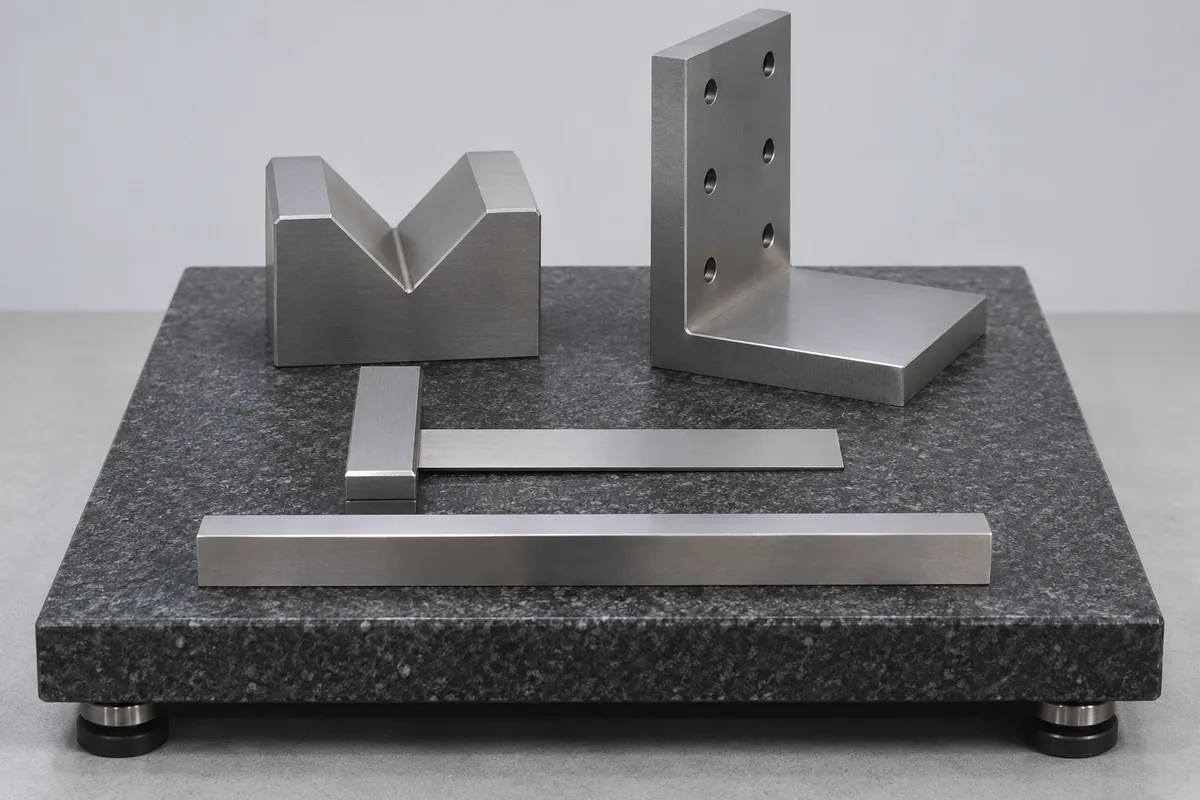
For a steel square, give the blade and stock dimensions and indicate the internal or external faces to be checked. A granite square needs each relevant face identified on a sketch. If a face has a relief, insert or damaged corner, show where it lies relative to the usable measurement area.
A combination square includes a head and a blade that work together. Keep their identification with the request, and say which head position or feature the procedure uses. A protractor head or centre head adds a separate function; list it explicitly rather than treating every accessory in the case as part of one squareness result.
Give the limit and the reference length
A limit stated as a deviation over a specified height needs that height recorded with it. Share the drawing, grade or instrument specification used for acceptance. Identify whether the request also includes straightness or parallelism of particular faces so these measurements can be reviewed as separate requirements.
Send the previous certificate if you want comparable results at the same positions. Mention a loose blade, a burr or a known impact, and record any adjustment already attempted. RTS can review the condition, geometry and reporting requirement before confirming the work. A result belongs to the identified faces and setup; preserve those references when the square returns to the inspection register.
The protractor head in a combination set
The combination-set entry in CC-4643 covers angular measurement from 0° to 180° at a least count of 1° in the permanent facility. It uses an angle gauge block set or vision measuring machine. This entry is useful when the order concerns the set's angular indication; it should not be read as a blanket statement about all squareness, centring or length functions in the case.
List the protractor head and blade together, with any identifying marks that keep them paired. Give the angles used by your inspection procedure and indicate the reference face. If the head can be read in more than one orientation, show the one used on the job. Send a sketch where the required angle could be taken between different faces.
A loose clamp or replaced blade belongs in the condition note. Include any earlier result you need repeated, then identify which other heads require separate checks. The final report should let the toolroom distinguish the angular result from a separate examination of the square head or centre head.
Protect the reference faces
Keep a heavy granite square separate from small accessories in the shipping case. Support it using the maker's handling instructions and provide its weight when arranging transport. For a combination set, list the heads and blade together and identify the department that owns them. Include any deadline tied to fixture acceptance with the initial enquiry.