
Build the list from the test sheets
For each function, give the level, unit and mode. AC requests also need frequency. Include the fitted options and note when an external amplifier, current coil or adapter is part of the setup. A previous result sheet can identify a combination that the front-panel model number does not.
Reference instrument downtime
Mark the functions that must be available when the calibrator returns. If another laboratory uses some functions and you require a particular reporting scope, identify that before booking. A portable loop source with only a current function can use the separate process current enquiry.
Avoid gaps between the function list and the report
A multifunction instrument can have separate voltage, current, resistance and other outputs, each with its own settings and accessories. Mark the modes used to make acceptance decisions and identify any function that may be omitted. For a requested pass or fail statement, send the applicable limit and its source. The quotation should make clear which points and conditions have been accepted for the work.
If the bench relies on a current coil, amplifier or adapter, give that item's identification and explain whether it must be included in the result. Keep earlier results when monitoring drift and request any required readings before an authorised adjustment. A recently failed or unstable function should be described as a fault first, so assessment and approval can be agreed before calibration is planned.
Dedicated voltage calibrators and DC sources
A voltage calibrator used as a bench reference may have no current or resistance function. Identify it as a dedicated source and list the output terminals, selected range, polarity and voltage points used. Include any divider output or external amplifier by its own model. For an AC output, add frequency to every requested point. A programmed setting, a separate monitor reading and the voltage delivered to a connected instrument are different records; say which one your procedure requires.
The CC-4643 permanent-facility DC voltage measure entries describe the laboratory measuring a source's output: separate ranges are listed from 1 mV through 1000 V on pages 6–7. They should not be confused with the source entries used when applying a reference to a customer's meter. Match each point and required uncertainty to the appropriate entry. Tell RTS about the connected load and any specified warm-up or output conditions. If the unit is used as a fixed voltage reference rather than an adjustable source, include its previous assigned values and the way your laboratory tracks drift.
Plan a bench handover
Identify the last production test before the calibrator can be released. Accessories sent separately should carry the calibrator's asset number as well as their own. Name the engineer who will check the returned results before restoring the reference to use.
Benchtop calibrators and the rack configuration
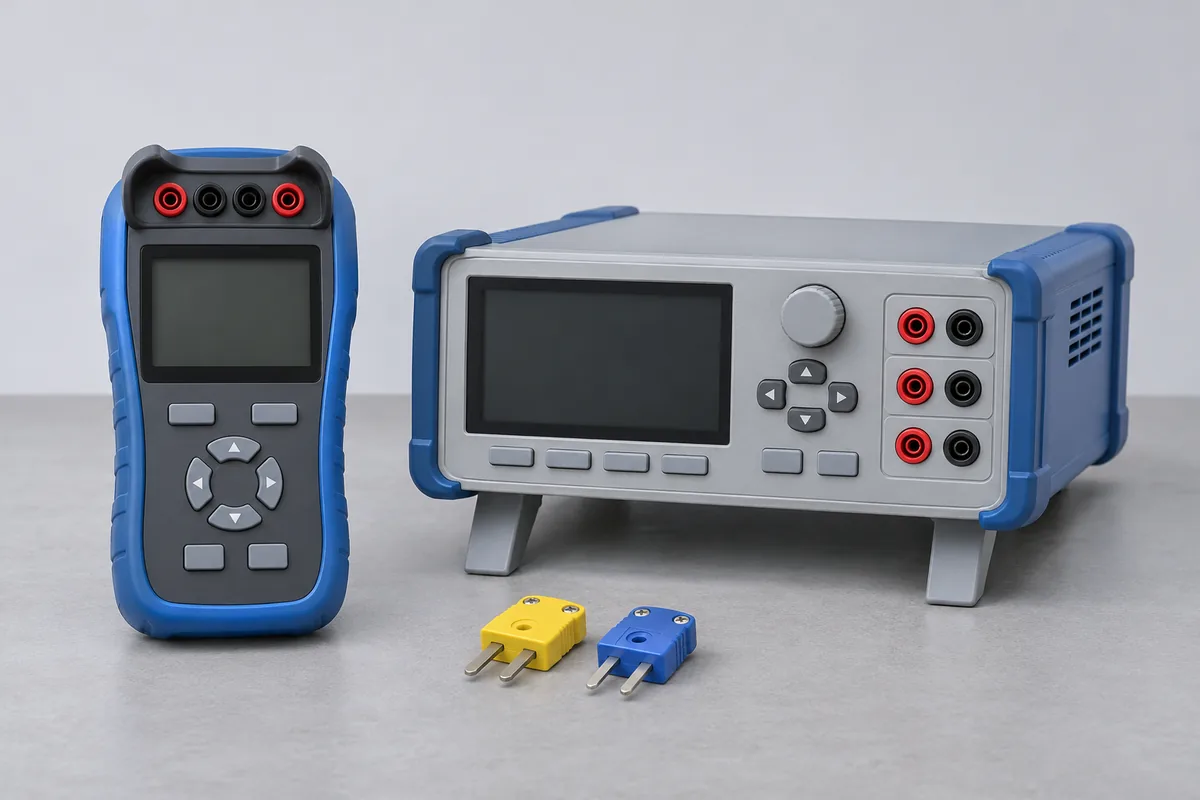
A benchtop calibrator may stay installed with an amplifier, switching unit and reference monitor. Identify the source itself and list the equipment connected to its output. Mark the voltage, current, resistance or other functions used by the bench. RTS needs the requested output points and connections before matching individual measurements to the electrical scope; the rack's combined specification is not a single calibration range.
An electrical calibrator with several functions
For an electrical calibrator, use a separate line for each source or measurement function. Include AC frequency, selected range and any external current coil. Tell us whether the order concerns the value generated, the input indication or both. A source setting and a meter reading require different reference arrangements, even when they are functions of the same instrument. Keep the manufacturer option list with the enquiry.
Portable calibrators used in the field
A portable calibrator often travels with a pressure module, temperature lead or loop supply accessory. Give each detachable item an identity and state which functions must be checked together. Record the normal battery or external-power arrangement and any field configuration that changes the output. Include actual working points rather than the widest printed rating, so the agreed report follows how the kit is issued to maintenance.
The electrical test bench as a measurement chain
A test bench can contain several independently identified instruments and a program that combines their readings. Provide the circuit or connection diagram, instrument list and the quantities used to accept the product. Separate calibration of those instruments from verification of the complete bench sequence. If software applies corrections, retain its revision and correction file with the request. RTS can review the required evidence at each stage of that chain.