
Pair each value with its test conditions
Group the requested points by inductance, capacitance and resistance. For each, record the test frequency and the series or parallel setting used. If your procedure specifies an AC excitation level, DC bias condition or a secondary reading such as dissipation factor, add it to the same row.
Match the fixture to the job
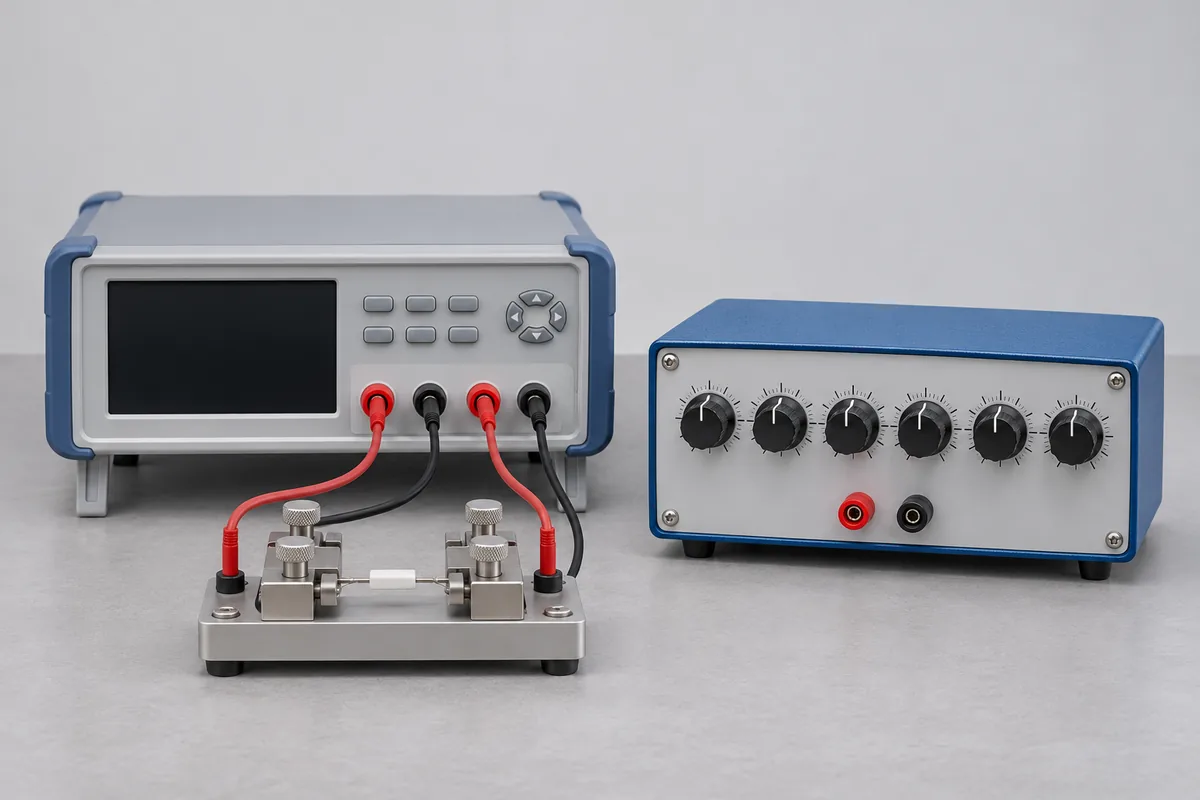
A handheld meter with tweezers and a bench meter with a four-terminal-pair fixture arrive with different accessories. Give the fixture model, identify the leads normally connected and note any adapters that stay permanently on the bench.
A meter that reads only capacitance or inductance
A capacitor inspection sheet might ask for 100 nF at 1 kHz. An inductance bench might use 10 mH at a different frequency. Enter the test frequency beside each requested value. If the meter sets its own frequency, give the model and selected range so RTS can check its operating conditions. Include any series or parallel setting available on the display.
A reading taken with short clips may differ from a reading through a long test fixture. Record which fixture the operator normally connects and whether the meter offers open or short compensation. Identify the fixture that must return with its meter. Ask for the quotation to specify the connector, reference values and frequencies RTS can cover.
Releasing a component inspection bench
Say whether the fixture can leave with the meter between inspection lots. For multiple sites, identify each bench and its return address even when all meters have the same model number.
Component testers with automatic results
A component tester may select a parameter automatically and report resistance, capacitance, inductance or semiconductor characteristics. Identify the functions and component types actually used for acceptance. Keep fixture, test level, frequency and equivalent-circuit settings with each requested result. RTS can review the applicable electrical comparisons individually. A valid resistance indication does not establish the tester's automatic classification or every semiconductor test offered in its menu.